
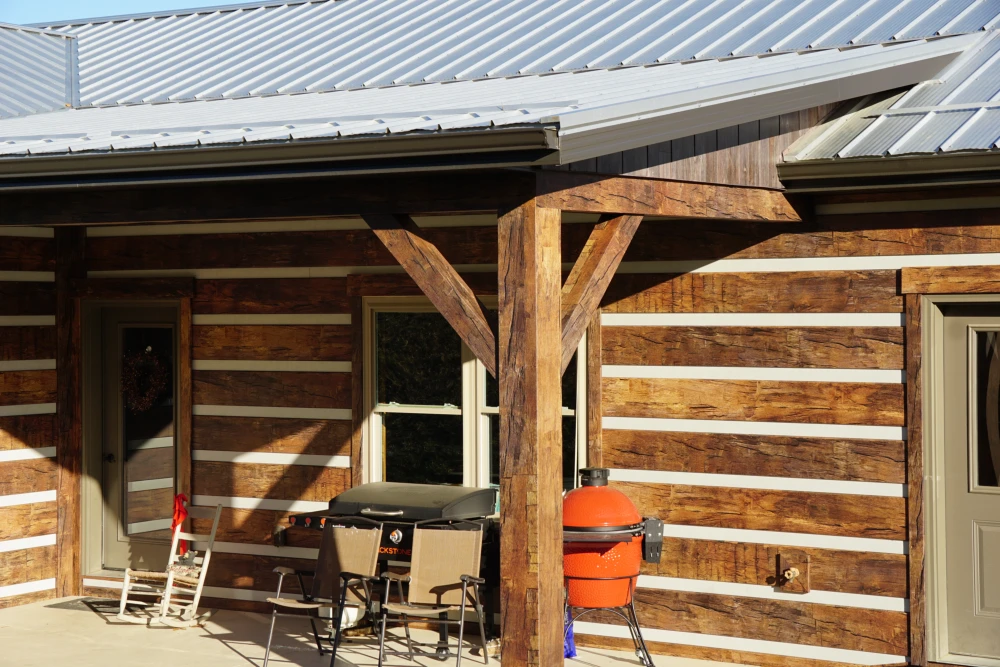
If you’ve already ruled out real wood and vinyl for your log cabin project, you’re ahead of most buyers. You understand that authentic timber requires more maintenance than most people can sustain, and that vinyl’s low price comes with low durability and an obvious plastic appearance. That leaves you choosing between two serious contenders: concrete log siding and steel log siding.
Both materials offer genuine durability, realistic wood aesthetics, and freedom from the constant upkeep that drives log home owners crazy. Both resist fire, insects, and rot. On paper, they might seem interchangeable. But after installing both materials, we can tell you the differences become obvious the moment you unload the first pallet.
This comparison isn’t about declaring one material worthless. Concrete log siding has legitimate strengths and works well for certain applications. Companies have built their reputation on quality concrete products, and their installations can look beautiful. But the two materials behave very differently during installation and ownership, and understanding those differences will help you make the right call for your specific situation.
The Weight Question Changes Everything
Pick up a twelve-foot concrete log siding panel, and you’ll immediately understand the first major difference between these materials. Depending on the profile, that single panel weighs between 40 and 70 pounds. Now imagine carrying it up a ladder, holding it in position against the wall, and driving fasteners while keeping everything level. You can’t do it alone. Concrete siding installation is strictly a two-person minimum operation, and on larger projects, three people make the work considerably safer and faster.
Steel log siding with foam backing weighs only a fraction of that. Our panels run roughly 16.2 pounds per 12-foot steel panel, which breaks down to individual panels light enough for one installer to handle comfortably throughout a full workday. That might sound like a minor detail until you calculate what it means for your project budget. Single-installer capability substantially reduces labor costs. It also means smaller crews can take on projects they’d otherwise have to pass on, which expands your options when hiring contractors.
Weight also affects what happens before installation even begins. Heavy concrete panels require more careful shipping and handling. Breakage during transport is a real concern that adds cost and delays. On-site, you need equipment or multiple workers just to move material from the delivery truck to the staging area. Steel panels can be carried by hand without special equipment, which helps logistics and reduces the chance of damage before a single fastener gets driven.
Then there’s the structural question. Concrete siding adds a substantial load to your walls. Most standard residential framing handles it fine, but your contractor needs to verify it, especially in renovations or buildings with longer stud spans. Steel siding with foam backing adds negligible weight to the structure. You won’t need engineering reviews or framing enhancements to accommodate the material.
Installation Speed and Real World Complications
Every contractor knows that the quoted installation time and the actual installation time rarely match up exactly. Materials that are easy to work with reduce the gap. Materials that fight you make the gap larger. This is where steel and concrete siding diverge sharply.
Cutting concrete siding requires diamond saw blades or specialized carbide tools. When the material is cut, it produces considerable dust, which requires respiratory protection and additional cleanup time. Cuts take longer than with other materials, and blade wear adds ongoing cost. Mistakes are expensive because you can’t easily trim or adjust a concrete panel once it’s cut.
On the other hand, steel siding can be easily cut with basic metal-cutting tools most contractors already own, such as tin snips and a circular saw with a metal-cutting blade, which is best for straight cuts. Electric shears can speed things up on larger projects. The material doesn’t fight back, dust is minimal, and minor adjustments happen quickly. An experienced installer develops a rhythm with steel that’s difficult to achieve with heavier, harder materials.
Panel alignment matters for final appearance, and this is where locking systems earn their keep. Concrete panels generally rely on careful positioning and fastening to maintain straight lines across long walls. Any slight misalignment compounds as you work across the wall, and fixing it means removing and repositioning heavy panels. Our Slide Lock system on SteeLuxe steel panels creates a mechanical interlock that automatically maintains alignment. The panels snap together consistently, sight lines stay true, and the installer can concentrate on efficiency rather than constantly checking and rechecking position.
Weather affects installation differently, too. Concrete panels are harder to handle in wet conditions because the surface becomes slippery and the panels are heavier. Cold temperatures don’t affect the concrete material itself, but it makes the physical demands of lifting the heavy panels more taxing on crews. Steel siding handles all weather conditions without major changes to the installation process. The foam backing of SteeLuxe siding provides a better grip for the installer, along with the panel’s light weight, productivity usually stays consistent regardless of the weather.
Material and Installation Siding Cost Comparison
Concrete log siding typically costs between $8 and $12 per square foot for materials, sometimes higher for premium profiles or custom colors. That price doesn’t include installation labor, which is much higher than any other siding type due to the weight, special handling requirements, and longer installation time.
Steel log siding pricing varies by manufacturer and specifications, but quality products with heavy-gauge steel, foam backing, and premium coatings generally cost around $8.50 per square ft, but delivers comparable or better performance than concrete siding. The real savings, though, show up in the installation labor. Faster installation with smaller crews results in much lower installation costs.
Both materials are very low-maintenance, so long-term upkeep costs are similar. Neither requires any painting or staining. Neither one attracts insects or rot. The performance difference shows up in the impact resistance and coating durability. Steel siding with Class 4 impact ratings handles hail, debris, and accidental impacts that could possibly crack or chip concrete. Premium coatings like Kynar 500 maintain color and finish longer than concrete finishes, which can develop wear patterns in high-usage or high-exposure areas over time.
Energy efficiency adds yet another layer to the cost analysis. Steel siding with foam backing provides an R-value of 3.5 or higher, built into the product. That’s meaningful thermal performance that reduces heating and cooling costs year after year. Concrete siding offers mass but minimal insulation value. In climates with significant temperature swings, the energy savings from insulated steel siding compound over the decades of ownership.
Siding Performance in Challenging Conditions
Both steel and concrete siding have Class A fire ratings, making them excellent choices for wildfire-prone regions where building codes restrict the use of combustible materials. Insurance companies may offer you a lower insurance premium than they would for a home with wood or vinyl siding. If fire resistance is your primary concern, both options serve you well.
The impact resistance of your siding choice should also be considered. Concrete siding is hard but can sometimes be brittle. A direct hit from something like a falling tree branch, a rock from a mower, or a hailstone with enough velocity can possibly crack or chip the surface of concrete siding. These aren’t concrete siding failures, but they’re visible damage that can affect the siding’s appearance and, over time, can possibly allow moisture to enter your home. Damaged concrete siding can normally be repaired using patching compounds, but they often don’t match perfectly.
Steel siding with a high-quality foam backing absorbs impacts better than most siding; it might dent if hit extremely hard, but it won’t normally crack. This helps prevent water intrusion that could damage the siding. The foam layer provides cushioning that prevents most minor impacts from showing. Class 4 impact rating means the product has been tested with two-inch-diameter steel balls dropped from substantial heights, simulating severe hail conditions. In places where summer storms regularly produce golf ball-sized hail, this rating matters. We’ve seen vinyl siding destroyed and concrete siding cracked on the same street where steel siding came through unmarked.
How siding products handle moisture intrusion is another important thing to consider. High-quality concrete siding resists water intrusion well, but some fiber-cement formulations can absorb moisture over time, especially if the surface coating is damaged. This can lead to swelling, warping, or freeze-thaw damage in cold climates. Steel siding is completely impervious to moisture absorption. When water hits the surface, it just runs off. There is zero absorption, no swelling, and no internal damage from freeze cycles. In wetter climates or locations with heavy snow loads, this makes a big difference for long-term performance.
Sound transmission is worth mentioning for homes in noisy areas. Concrete’s thickness provides some sound dampening, which is a genuine advantage. But steel siding with the foam backing offers comparable acoustic benefits because the foam effectively absorbs sound vibrations. Neither siding material leaves you with a noticeably louder interior than the other, despite common assumptions about metal being noisier.
Appearance and Design Flexibility
Both materials can achieve remarkably realistic wood appearances. Modern manufacturing techniques create deep textures, authentic grain patterns, and color variations that fool visitors into thinking they’re looking at real timber. The question is how many options you have and how closely they match your vision.
Concrete siding typically offers a handful of standard colors with custom colors available at additional cost and lead time. The casting process used to create concrete panels limits the variety of textures and profiles available. What you see in the catalog is generally what you can get.
The printing and coating process for steel siding provides a greater variety of options. At SteeLuxe, we offer 50 solid colors and 22 wood-grain patterns, giving you options most homeowners never expected in a metal product. We’re also the only steel siding manufacturer producing a chinking profile, that distinctive caulked line between logs that defines traditional cabin construction. And our hand-hewn timber pattern creates a look you literally cannot get from any other steel siding company. If your home design vision goes beyond the basic look of log profiles, then steel offers more ways to achieve it.
Siding panel orientation options add another design consideration for you to think about. Our ten-inch Steel siding panels can be installed horizontally or vertically without modification, enabling accent walls, mixed orientations, and creative applications that would require different products with most siding systems. Concrete panels are typically designed for a single orientation only, limiting their design flexibility.
Making the Right Choice for Your Siding Project
Concrete log siding can make sense for projects where the extra weight isn’t a concern, the budget allows for higher material and labor costs, and the available profiles match your design goals. The concrete siding has proven itself over decades, and quality installations look excellent and last for generations.
Steel log siding makes sense for projects where installation efficiency matters, budget optimization is important, impact resistance is a priority, insulation value adds benefit, or design flexibility requires more options than concrete can provide. The material represents newer technology that solves problems contractors and homeowners have struggled with for years.
We obviously believe steel siding, particularly SteeLuxe, offers the best overall value for most log cabin-style projects. We designed it specifically to address all the shortcomings we encountered during the installation of other siding products. The weight advantage alone completely changes the installation experience. The Class 4 impact resistance, premium coatings, built-in insulation, and design options that no one else offers make the decision straightforward for most buyers.
But we also know every project usually comes with unique requirements, and the best way to evaluate your options is to get samples of both materials in your hands and discuss your specific situation with an experienced installer who has worked with both products. That way, you can make an informed decision based on your project priorities.
We welcome your call, or a call from your contractor, to discuss whether SteeLuxe is suitable for your project and compare it accurately against alternatives. We’re confident in the numbers, and we think you will be too.