
Steel Siding & Hand Hewn Log Siding in Oklahoma
Steel Siding in Oklahoma
Steel siding in Oklahoma answers for three conditions in a climate that tests exterior materials every year. Oklahoma City sits in the most tornado-active major metro in the country, and the 2013 EF5 that destroyed large sections of Moore set the benchmark for what wind-driven impact does to standard siding. Hail large enough to damage roofing and siding occurs multiple times each year across most of the state. Freeze-thaw cycling runs November through March, summer heat regularly exceeds 100 degrees, and termites are active across the OKC and Tulsa metros and throughout eastern and central Oklahoma. Wood grain siding in the 22 patterns SteeLuxe manufactures covers the Oklahoma range, from the craftsman and ranch profiles of the suburbs to the rustic profiles of Green Country and the Ouachita corridor.
Cold and heat both arrive in Oklahoma with enough intensity to work exterior materials from both ends of the thermal range. Oklahoma City and Tulsa average January lows near 28 degrees with freeze-thaw cycling from November through March. Panhandle communities like Guymon average January lows near 18 degrees with a freeze-thaw season from October through April. Summer highs regularly exceed 100 degrees, cycling exterior surfaces through more than 70 degrees of temperature change each year.
Hail is Oklahoma's most consistent exterior material threat, arriving with supercell thunderstorms from late March through June and again in the fall. Golf-ball-size and larger events occur across most of the state every year, most frequently in the central and western counties around Oklahoma City and Lawton. Class 4 impact resistance is the specification that separates steel from every other siding material at an Oklahoma address, and the rating insurance carriers use when calculating premium discounts on impact-resistant products.
Tornado and straight-line wind exposure in Oklahoma is the most severe in the country for residential construction. Moore has been struck by significant tornadoes multiple times since 1998, and the Oklahoma City metro sees more tornado activity than any comparable urban area in the United States. Straight-line winds of 70 to 90 miles per hour accompany severe thunderstorms multiple times each season, loading panels with lateral force and wind-driven debris well short of a tornado's direct path.
Termites are active across Oklahoma from April through October, with the heaviest pressure in the OKC metro, the Tulsa metro, and the eastern counties from Muskogee south through the Ouachita region. Eastern subterranean termites are present statewide, and Formosan termites are active in the southeastern counties of McCurtain, Choctaw, and Pushmataha. Oklahoma's warm springs and humid summers give colonies an extended active season, and the large inventory of wood-framed homes in established neighborhoods gives them the food source and access they need.
Oklahoma's three conditions don't separate cleanly by region. Hail and tornado exposure are statewide. Freeze-thaw cycling is most severe in the panhandle but present across every county from November through March. Termite pressure is heaviest in the eastern and central counties but active in every major metro. Steel answers all three without separate products or upgrades.
The Most Advanced Steel Siding On The Market
- 20 Year Fading & Chalking Warranty
- 50 Year Flaking & Peeling Warranty
- Lasts 40-60+ Years
- One Person Installation
Climate & Conditions Across Oklahoma
Oklahoma's conditions are distributed across every county, and the difference between an Oklahoma City address and a Tulsa address is less about which conditions apply than about which arrive first each season.
Oklahoma City and the metro communities of Norman, Edmond, Midwest City, Moore, and Yukon represent Oklahoma's largest residential siding market and the state's most historically active tornado corridor. Moore's repeated tornado strikes, including the 1999 F5, the 2003 EF4, and the 2013 EF5, have made it the most tornado-tested residential community in the United States and established a clear baseline for what exterior construction in the southern OKC metro has to survive. The metro averages a January low near 28 degrees, summer highs above 100 degrees, annual hail events with golf-ball-size or larger stones, and active termite pressure through the growing season.
Tulsa and the northeast Oklahoma communities of Broken Arrow, Owasso, Bixby, Sand Springs, and Bartlesville represent the state's second-largest metro market and its most active residential renovation corridor. Green Country's higher humidity and tree canopy compared to western Oklahoma give termite colonies a more favorable environment, and the Tulsa metro's large stock of mid-century craftsman and colonial homes in established neighborhoods drives consistent re-siding demand. Hail and tornado exposure in the Tulsa corridor match the OKC metro, and the January low near 28 degrees puts freeze-thaw cycling in the same November-to-March window.
Lawton and the southwest Oklahoma communities of Anadarko, Chickasha, and Duncan represent Oklahoma's most tornado-exposed corridor outside the OKC metro. Comanche County and the surrounding counties sit in the highest-frequency tornado zone in the state, and the open terrain of southwest Oklahoma gives supercell thunderstorms an unobstructed path and produces frequent large-hail events. The combination of tornado exposure, annual large-hail events, hot summers, and winter freeze-thaw cycling makes Class 4 impact resistance the most important siding specification in this corridor.
Muskogee, Tahlequah, Stilwell, and the communities of eastern Oklahoma represent the state's most active termite corridor and a significant secondary market for residential re-siding. Eastern Oklahoma's higher humidity, denser tree cover, and warmer spring temperatures extend the termite active season and give both eastern subterranean and Formosan colonies a more favorable environment than the drier western part of the state. Hail and tornado exposure remain significant in eastern Oklahoma, and the freeze-thaw cycling that runs from November through March applies across the full region.
Need help finding an installer?
Why Steel Siding Is Right for Oklahoma
Three conditions are active across every Oklahoma county, and the Oklahoma City metro and Tulsa metro carry all three at peak intensity through the active storm season. Each has a direct failure pattern in the materials most Oklahoma homes currently carry, and each has a clear answer in 26-gauge steel.
Hail is Oklahoma's most frequent cause of exterior material damage, and Class 4 impact resistance separates steel from every alternative. Golf-ball-size hail events occur across most Oklahoma counties every year, and a panel surface that cracks under that impact starts a failure sequence that admits water behind the wall. Vinyl cracks under large hail and doesn't carry a Class 4 rating. Fiber cement chips and fractures under direct hail strikes. Steel's 26-gauge panel takes Class 4 hail without cracking or admitting water, and carries that rating on every panel as a standard specification.
Tornado and straight-line wind exposure puts lateral load and wind-driven debris against siding panels on a regular Oklahoma schedule. A panel that cracks or separates from the wall under that load exposes the wall assembly at exactly the wrong moment. Class 4 impact resistance covers debris strikes as well as hail: a panel rated for golf-ball-size hail at terminal velocity holds under wind-driven material at storm speeds. Steel won't crack from debris impact and won't peel from the wall under the lateral wind loads that Oklahoma severe weather delivers multiple times each season.
Termites across the Oklahoma City metro, the Tulsa metro, and eastern Oklahoma find steel siding nothing to exploit. Eastern subterranean colonies active from April through October need wood to eat, and the large inventory of wood-framed homes in established OKC and Tulsa neighborhoods gives them a ready supply. Steel gives them nothing at the panel surface. In the southeastern counties where Formosan termites are active alongside eastern subterranean colonies, steel makes the exterior wall an entry point for neither species.
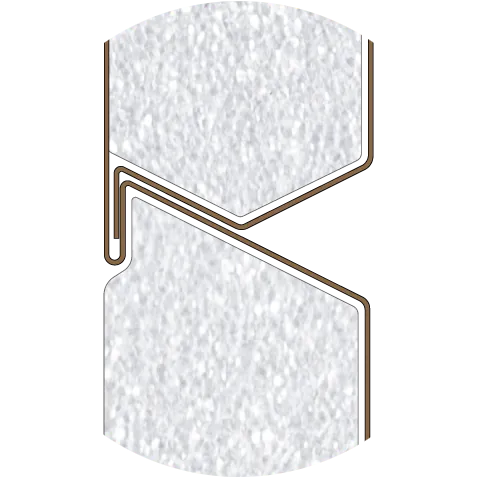
Oklahoma's thermal range cycles exterior materials from January lows near 28 degrees to summer highs above 100 degrees, compressing freeze-thaw cycling and summer heat expansion into the same annual calendar. Ice storms that arrive most winters coat panels with ice load that compounds freeze-thaw stress at fastener points and panel edges. Steel's Slide-Lock panel system accommodates that full dimensional range at the joint level, holding the connection without creating gaps or loosening fasteners through Oklahoma's complete thermal cycle.
Product Specifications
| Spec | Value |
|---|---|
| Gauge | 26-gauge steel (~25% thicker than 29-gauge) |
| Core | EPS foam, R-3.57 continuous insulation value |
| Fire Rating | Class A (highest available) |
| Impact Rating | Class 4 (highest available) |
| Colors | 50 solid colors (Sherwin Williams WeatherXL) |
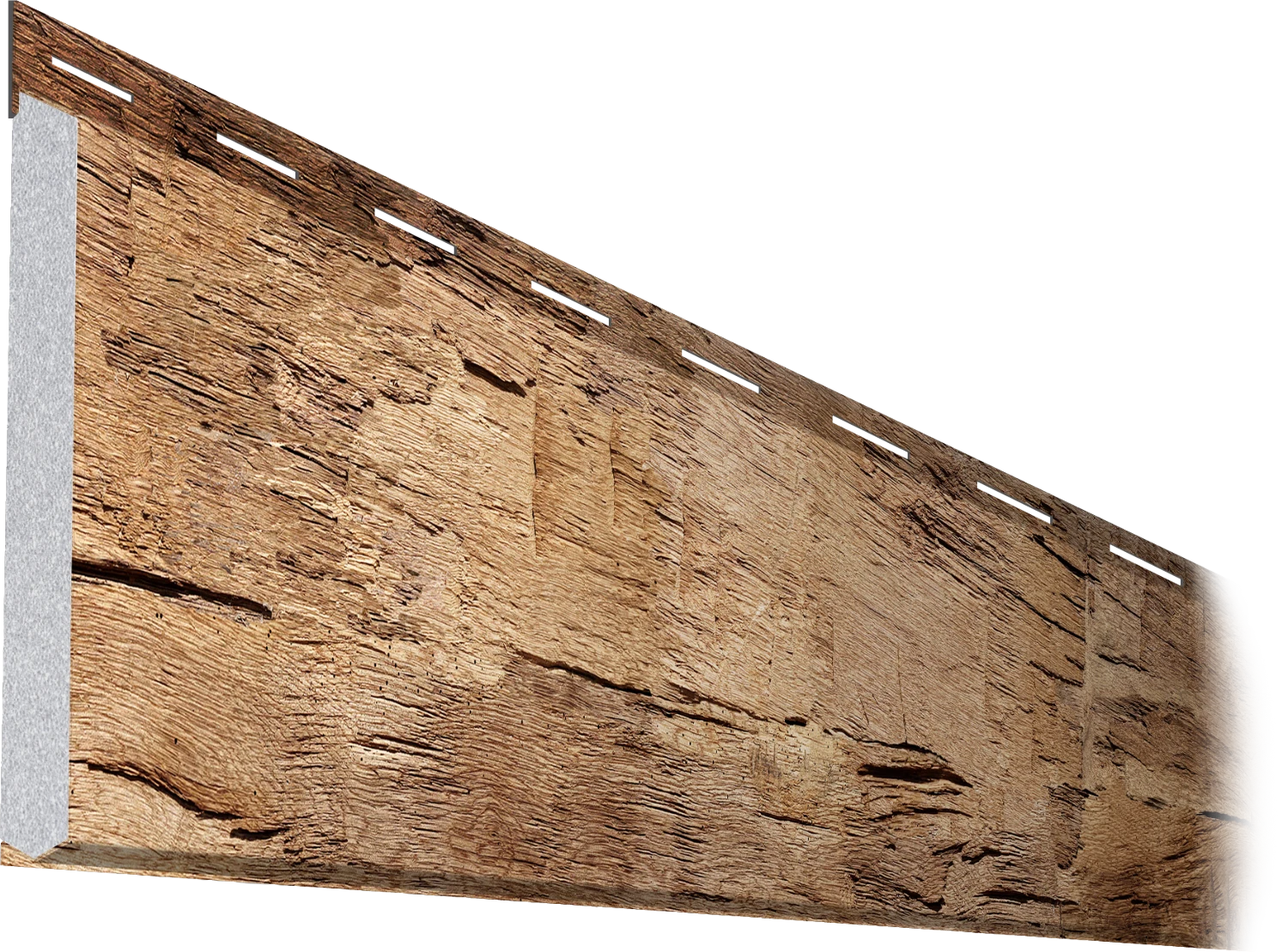
| Wood Grain | 22 patterns (Kynar 500 resin) |
| Log Profile | Hand hewn log siding with chinking — 4 chinking colors |
| Warranty | 50-year peeling/flaking | 20-year fade/chalk |
| Panel | 10-inch planks, Slide-Lock system, one-person install |
| Base Coat | AZ55 Galvalume (zinc-aluminum alloy corrosion barrier) |
| Origin | New Philadelphia, Ohio — direct ship to all 49 states |
Hand Hewn Log Siding with Chinking
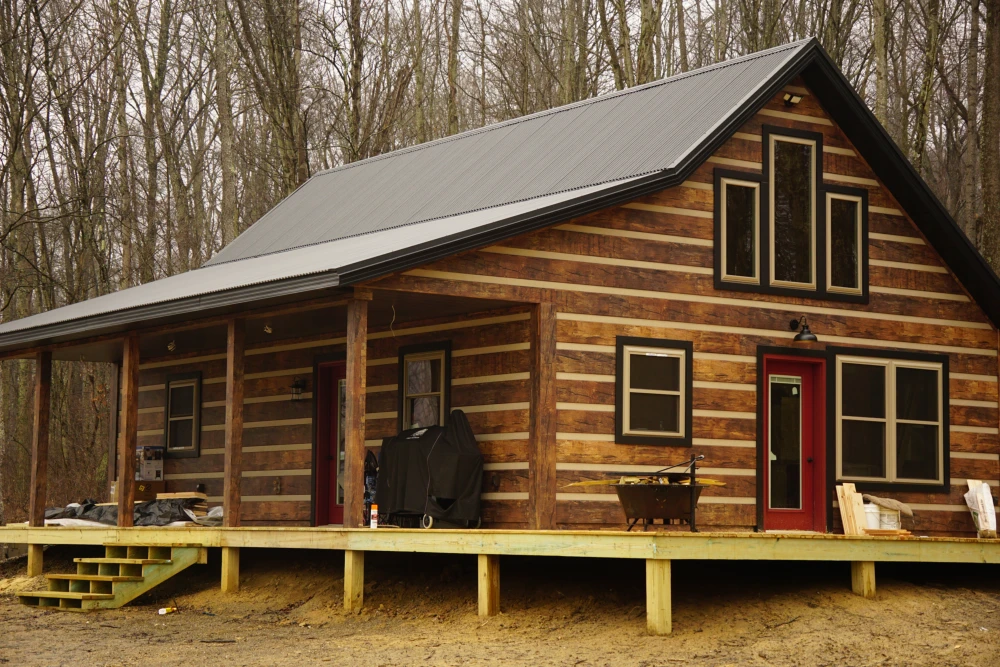
Eastern Oklahoma's Green Country and the Ouachita Mountain corridor carry a large stock of rural properties, lake cabins, hunting retreats, and ranch homes where the log and rustic aesthetic defines the exterior. Lake Eufaula, Lake Tenkiller, and the surrounding lakes anchor a recreational property market where the log cabin profile is the standard aesthetic and weather performance is the practical specification.
Real wood log siding at an eastern Oklahoma lake cabin or Ouachita Mountain property faces the full Oklahoma condition set. Freeze-thaw cycling works moisture into log joints and cracks them open through the winter. Termites in the southeastern counties treat log siding as a direct food source and entry pathway into the wall framing. Hail reaches eastern Oklahoma on the same supercell track as the rest of the state, and wood carries no impact resistance rating.
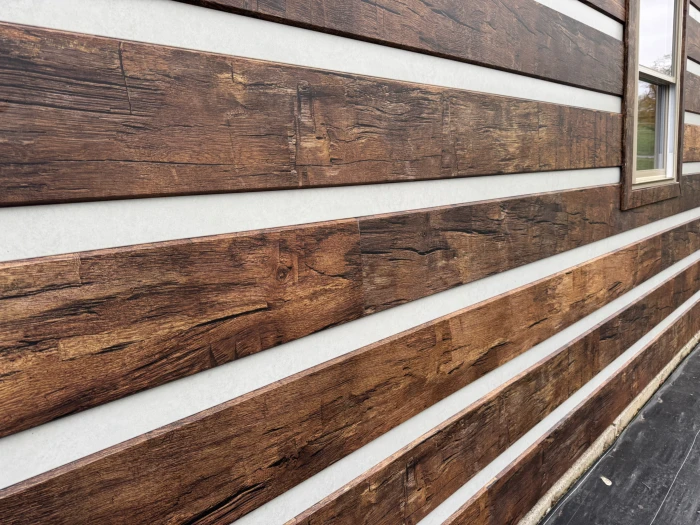
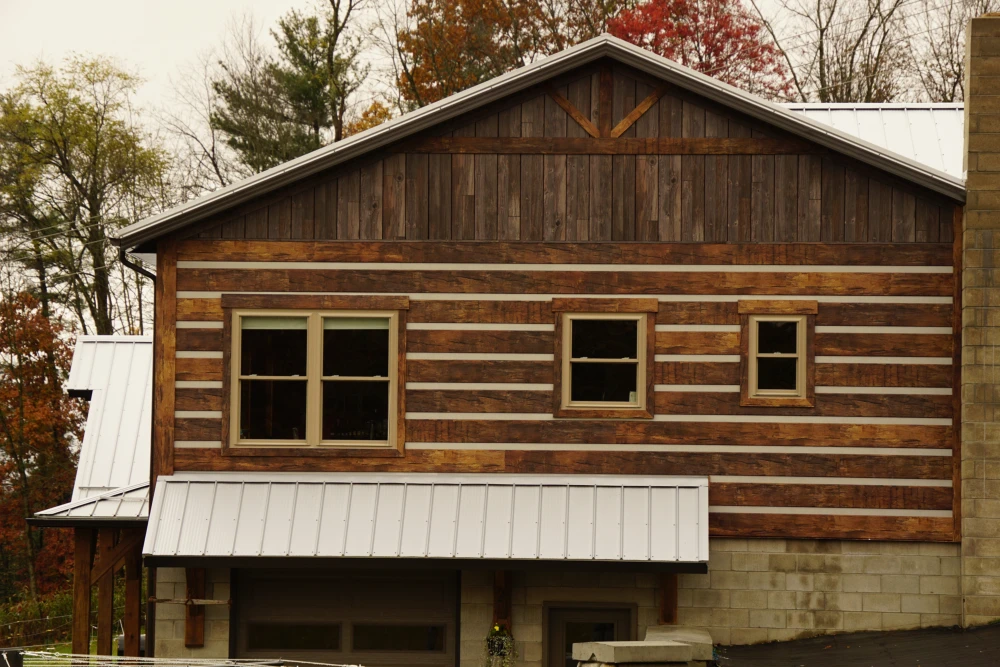
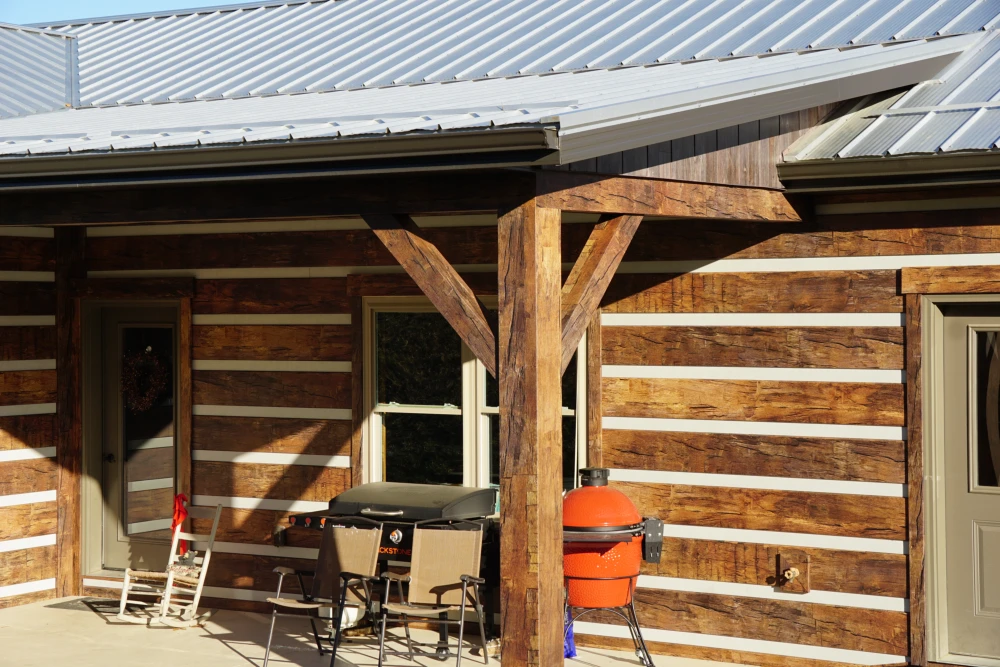
Hand hewn log siding with chinking in 26-gauge steel delivers the Green Country and Ouachita lake cabin aesthetic without those failure modes. Steel doesn't absorb moisture, so freeze-thaw cycling has nothing to act on at the log joints. Class 4 impact resistance means the panel takes direct hail strikes without cracking, and steel gives termites nothing to eat. Chinking fills the joints in four colors: Ash Gray, Charcoal, Clay, and Sandstone Tan. From the road or the water, it reads as traditional log construction.
SteeLuxe is the only manufacturer making hand hewn log siding with chinking in steel. It ships direct from New Philadelphia, Ohio to lake cabins, hunting retreats, and rural and year-round homes throughout eastern Oklahoma's Green Country and the Ouachita corridor, and is available across all 22 wood grain patterns in the SteeLuxe line.
Ready to Transform Your Home With Hand-Hewn Log Cabin Siding?
Get the authentic hand-hewn cabin look with the chinking detail you love, and never think about maintenance again. SteeLuxe steel siding is insulated, fire-rated, hail-resistant, and built to last a lifetime. See it and feel it for yourself.
Steel Siding vs the Alternatives
Oklahoma's hail, tornado, and termite conditions test the three most common siding alternatives against a specification that requires impact resistance, structural integrity under wind load, and pest resistance at the same address. Steel meets all three. Each alternative fails on at least two fronts in Oklahoma's climate.
Vinyl is the most common siding on Oklahoma homes, and the state's hail events expose its central failure mode faster than almost anywhere else. Direct hail impact cracks vinyl panels, and cracked panels admit water behind the wall assembly with every subsequent rain event. Vinyl carries no Class 4 rating and no Class A fire rating, leaving Oklahoma addresses without rated impact protection through every storm season. Cold is a secondary liability: Oklahoma's freeze-thaw cycling makes vinyl brittle through the winter months, cracking at fastener points under thermal stress before the storm season even begins. Termites enter wall assemblies through gaps at penetrations and trim joints regardless of the panel material at the surface.
Fiber cement handles Oklahoma's hail better than vinyl but chips and fractures under direct large-hail impact, and standard fiber cement product lines don't carry a Class 4 impact resistance rating. Its Oklahoma liabilities are hail damage at the panel surface, moisture absorption at cut edges, and a paint cycle that the state's hot summers and wet spring storm seasons shorten faster than national average estimates. Cut edges at penetrations, windowsills, and trim joints absorb moisture through Oklahoma's wet spring and fall seasons, and the freeze-thaw cycle works that moisture through dozens of hard freezes each winter. Fiber cement also gives termites nothing to eat at the panel surface but offers no barrier to termites reaching the wood framing behind the panel.
Wood siding in Oklahoma faces failure from all three conditions. Direct hail impact dents and cracks wood panels, and paint on wood degrades in 5 to 7 years under Oklahoma's heat, UV, and freeze-thaw cycling. Eastern subterranean termites treat wood siding as a direct food source and entry pathway into wall framing, and in the southeastern counties, Formosan termites do the same with more aggressive colony behavior. Tornado and straight-line wind events load wood panels with lateral stress and debris impact through a storm season that runs from March through June and returns in the fall. Steel ends the paint cycle, carries Class 4 impact resistance, and gives termites nothing to eat.
Frequently Asked Questions
Q:What makes SteeLuxe steel siding different from other steel siding products?
Q:How does the Slide-Lock installation system work?
Q:What wood grain patterns are available?
Q:Does steel siding rust?
Q:How does Class 4 impact resistance protect Oklahoma homes from hail?
Q:Is steel siding a good choice for Oklahoma homes in tornado-prone areas like Moore and the OKC metro?
Q:How does termite pressure affect Oklahoma homes, and does steel siding help?
Q:Does SteeLuxe install in my city?
Q:What should I know about siding for an eastern Oklahoma lake cabin or rural property?
Oklahoma Cities & Regions We Serve
SteeLuxe ships from New Philadelphia, Ohio to residential, rural, and contractor projects across all 77 Oklahoma counties, with lead times that work for the year-round OKC and Tulsa metro markets and the seasonal construction windows of eastern Oklahoma's lake and rural communities.
Oklahoma City, Norman, Edmond, Midwest City, Moore, and Yukon represent Oklahoma's largest residential siding market. Annual hail events, tornado exposure, freeze-thaw cycling, and active termite pressure make the OKC corridor the state's highest-volume re-siding market, and the large stock of postwar ranch and craftsman homes drives consistent demand through the full construction season.
Tulsa, Broken Arrow, Owasso, and Bixby represent the state's second-largest metro market, where Green Country's higher humidity adds termite pressure alongside the same hail, tornado, and freeze-thaw conditions as the OKC metro. Mid-century craftsman and colonial homes in established Tulsa neighborhoods drive consistent re-siding demand, and the profiles common in Brookside, Midtown Tulsa, and Broken Arrow are well matched to the SteeLuxe wood grain line.
Lawton, Chickasha, and Anadarko represent the southwest Oklahoma market, where open terrain and direct supercell exposure give this corridor the state's most frequent large-hail and tornado events. Class 4 impact resistance is the primary specification driver here, and re-siding demand is consistent through the spring and summer construction season.
Muskogee, Tahlequah, and Stilwell represent the eastern Oklahoma market, where the state's heaviest termite pressure and a large inventory of lake and rural properties combine. Lake Eufaula, Lake Tenkiller, and the surrounding recreational property market drive demand for the hand hewn log siding with chinking profile, and Green Country's longer termite season makes steel's pest resistance the defining re-siding specification.
Full city pages with local installer contacts and current pricing are available for Oklahoma City, OK. More Oklahoma cities are listed below:
Don't see your city listed here. Contact SteeLuxe directly and someone familiar with Oklahoma's regional conditions will point you to the nearest installer and current pricing for your area.
Get a Quote for Steel Siding in Oklahoma
SteeLuxe is manufactured in New Philadelphia, Ohio and ships direct. Whether you are planning a full re-siding project or exploring options, we can get you pricing, color samples, and a list of installers in your area.