
Steel Siding & Hand Hewn Log Siding in Ohio
Steel Siding in Ohio
Every SteeLuxe steel siding panel is manufactured in New Philadelphia, Ohio. That is not a footnote. The product wasn't built for a generic national market. It was built by people who work Ohio winters, watch Ohio hailstorms come through in June, and have seen firsthand what five months of Great Lakes humidity does to a siding job that wasn't built to handle it.
Ohio's climate covers a lot of ground. January averages 16 degrees statewide, and the Lake Erie shoreline gets colder when lake-effect snow pulls Arctic air down from Canada. Hail season runs May through September, and the I-71 corridor from Columbus to Cleveland, plus the southwestern corner of the state, sees 50 to 70 significant hailstorms in most years. Summer humidity sets in around May and doesn't leave until October. Termites are active across all 88 Ohio counties, with the heaviest pressure in the southwestern counties near the Kentucky line.
For siding, that adds up to four tests: cold and freeze-thaw cycling, hail, moisture, and termites. Steel handles all four without compromise, and no other single material comes close to that combination in Ohio's climate.
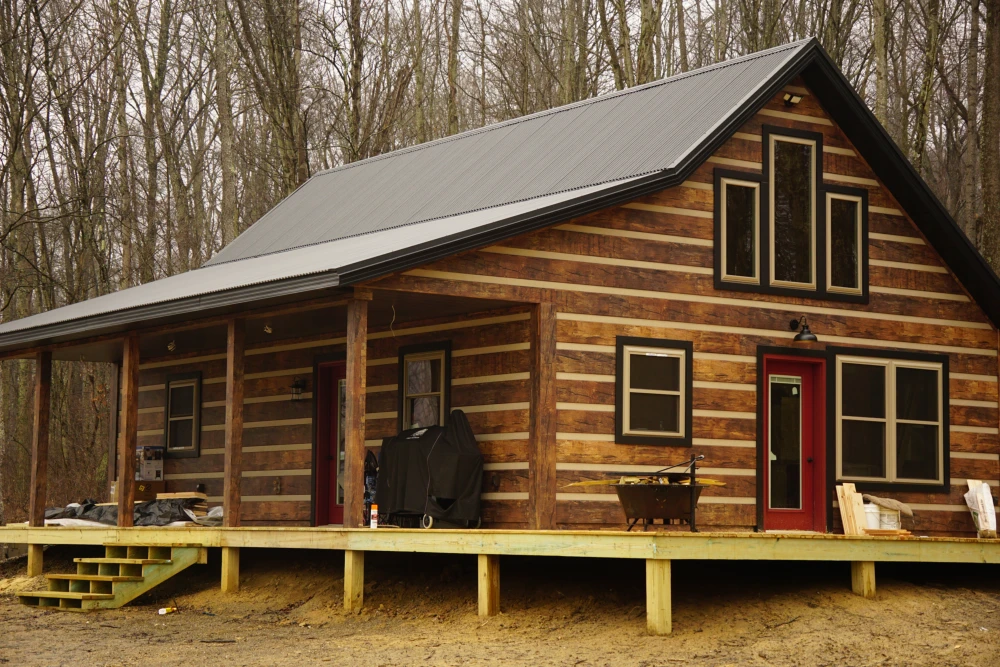
In sub-zero cold, vinyl goes brittle and cracks when hail hits. Steel doesn't. Class 4 impact resistance means the panel holds up under a hit that would split vinyl or chip fiber cement. Steel doesn't soak up moisture, doesn't swell, and there's nothing in it for termites to eat. The AZ55 Galvalume coating fights rust from inside the material itself, not from a surface coat that wears off over the years. Wood grain siding in the SteeLuxe line gives homeowners in older Ohio neighborhoods the craftsman profiles and Victorian details that vinyl has never been able to match.
SteeLuxe started in Ohio. Siding professionals with 25 years of field work in this state built the product, and the warranties say what they say because the founders have seen what Ohio weather does to exterior materials over a long time. The 50-year peeling and flaking warranty and the 20-year fade warranty aren't marketing copy. They're what the product is actually built to do.
Ohio's climate looks different depending on where you are in the state. Cleveland and Cincinnati are only 240 miles apart from each other but face genuinely different problems keeping a house properly sided for the long term. The lake effect is real up north. Cincinnati has the worst termite season in Ohio. Toledo faces flat-terrain cold that most of the state doesn't. This page covers all four of Ohio's main climate zones.
The Most Advanced Steel Siding On The Market
- 20 Year Fading & Chalking Warranty
- 50 Year Flaking & Peeling Warranty
- Lasts 40-60+ Years
- One Person Installation
Climate & Conditions Across Ohio
Ohio weather surprises people who didn't grow up here. The Lake Erie shoreline and the Ohio River are only 200 miles apart, but the siding conditions at those two ends of the state are genuinely different.
Northeast Ohio: Cleveland, Akron, and the Lake Erie Shore
Cleveland and the northeast Ohio shore get hit harder in winter than anywhere else in the state. Lake-effect snow off Lake Erie drops heavy snowfall on Cleveland, Euclid, and Lorain while Columbus gets a regular Ohio winter. The bigger issue for siding is what happens after each storm: it freezes, thaws out, then freezes again. That's why vinyl fails here. Each cycle makes the panels expand and contract, and over time they pull loose from their fasteners or crack at the seams in ways that let water behind the wall. Steel moves with temperature changes the same way every time, so those cycles don't build up to damage the way they do in vinyl. Hail also tracks up the I-71 corridor into Cleveland regularly.
Central Ohio: Columbus and the Interior
Columbus is the state's biggest siding market, far enough from Lake Erie to skip the lake-effect snow but still dealing with cold winters, a full hail season, and the summer humidity that covers all of Ohio. The I-71 corridor through Columbus toward Cincinnati is one of the more consistent hail tracks in the state, and termite pressure is active across the Columbus suburbs and the surrounding counties. SteeLuxe's one-person Slide-Lock install has made it a practical choice for the high volume of new build and re-siding work here.
Southwest Ohio: Cincinnati and the River Counties
Cincinnati is Ohio's warmest city and has the worst termite problem in the state. Being right above the Kentucky line pushes the southwestern counties into higher termite territory, where the season runs longer and colonies are more active than anywhere else in Ohio. Summer humidity here is intense and sticks around. Wood siding and fiber cement both absorb that moisture, which makes paint peel faster and starts to break down the material underneath over time. Steel doesn't absorb any of it, and there's nothing in it for termites to eat.
Northwest Ohio: Toledo and the Maumee Valley
Toledo sits at the western end of Lake Erie, where cold air coming down from Canada meets the lake system and creates its own rough Ohio winter. The Maumee Valley is flat and wide open with nothing to slow the wind, so cold air hits the house from all directions without hills or trees to break it up. Hail runs through northwest Ohio regularly from spring into fall, and cold, wind, and hail together make this one of the harder parts of the state for exterior siding.
Ohio puts four conditions on exterior siding simultaneously: cold, hail, termites, and humidity. Steel handles all four in the same panel without making you trade off one condition for another, and no single alternative comes close to that combination in Ohio's climate.
Need help finding an installer?
Why Steel Siding Is the Right Spec for Ohio
Four conditions: cold, hail, termites, and humidity. Here's what each one does in practice and why 26-gauge steel is the only material that handles all of them in the same panel without compromise.
Cold is the starting condition. Ohio averages 16 degrees in January, and the Lake Erie corridor goes colder when lake-effect systems come through. Here is the specific problem with vinyl in Ohio cold: below 20 degrees, vinyl goes brittle and can't flex the way it does in warmer weather. So when a hailstorm comes through in October or November, it hits panels that are already stiff and cold, and they crack instead of giving. Steel doesn't go brittle at any temperature Ohio produces. It expands and contracts the same predictable amount every time, and the Slide-Lock panel system is built to handle that movement without seams pulling open.
Hail is the second condition, and Ohio is serious about it. The I-71 corridor from Cincinnati through Columbus to Cleveland sees consistent hailstorms, and the southwestern corner of the state gets 50 to 70 significant events in most years. Class 4 is the highest impact rating the IBHS awards for exterior siding, and a Class 4 panel takes a two-inch steel ball dropped from 20 feet without cracking. Ohio insurance companies in high-hail zip codes recognize that rating when they set premiums.
Termites are the third condition, and they're active across all 88 Ohio counties. The pressure is moderate to heavy statewide, with the southwestern counties near the Kentucky border carrying the highest activity in Ohio. Steel gives termites nothing to work with. There's no wood in it, no food, and no moisture for a colony to use, which means termites can't eat it, can't tunnel through it, and can't establish themselves anywhere near it. That holds on day one and it still holds 40 years later.
Humidity is the fourth condition, running across the whole state from May through October. Fiber cement absorbs moisture through those months at a rate that makes paint peel every 7 to 10 years. Wood siding swells and warps in sustained humidity, holding moisture right at the wall. Steel absorbs nothing, and the AZ55 Galvalume coating is a corrosion barrier built into the metal itself.
Product Specifications
| Spec | Value |
|---|---|
| Gauge | 26-gauge steel (~25% thicker than 29-gauge) |
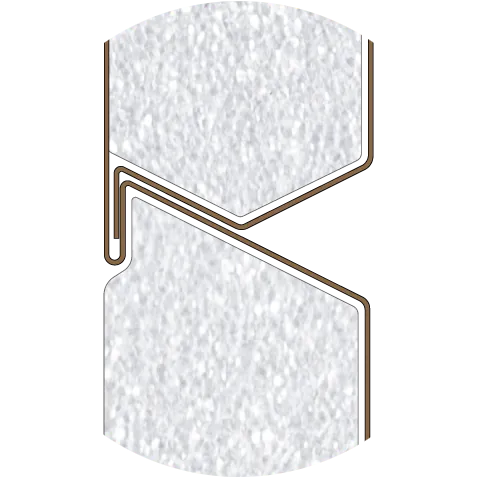
| Core | EPS foam, R-3.57 continuous insulation value |
| Fire Rating | Class A (highest available) |
| Impact Rating | Class 4 (highest available) |
| Colors | 50 solid colors (Sherwin Williams WeatherXL) |
| Wood Grain | 22 patterns (Kynar 500 resin) |
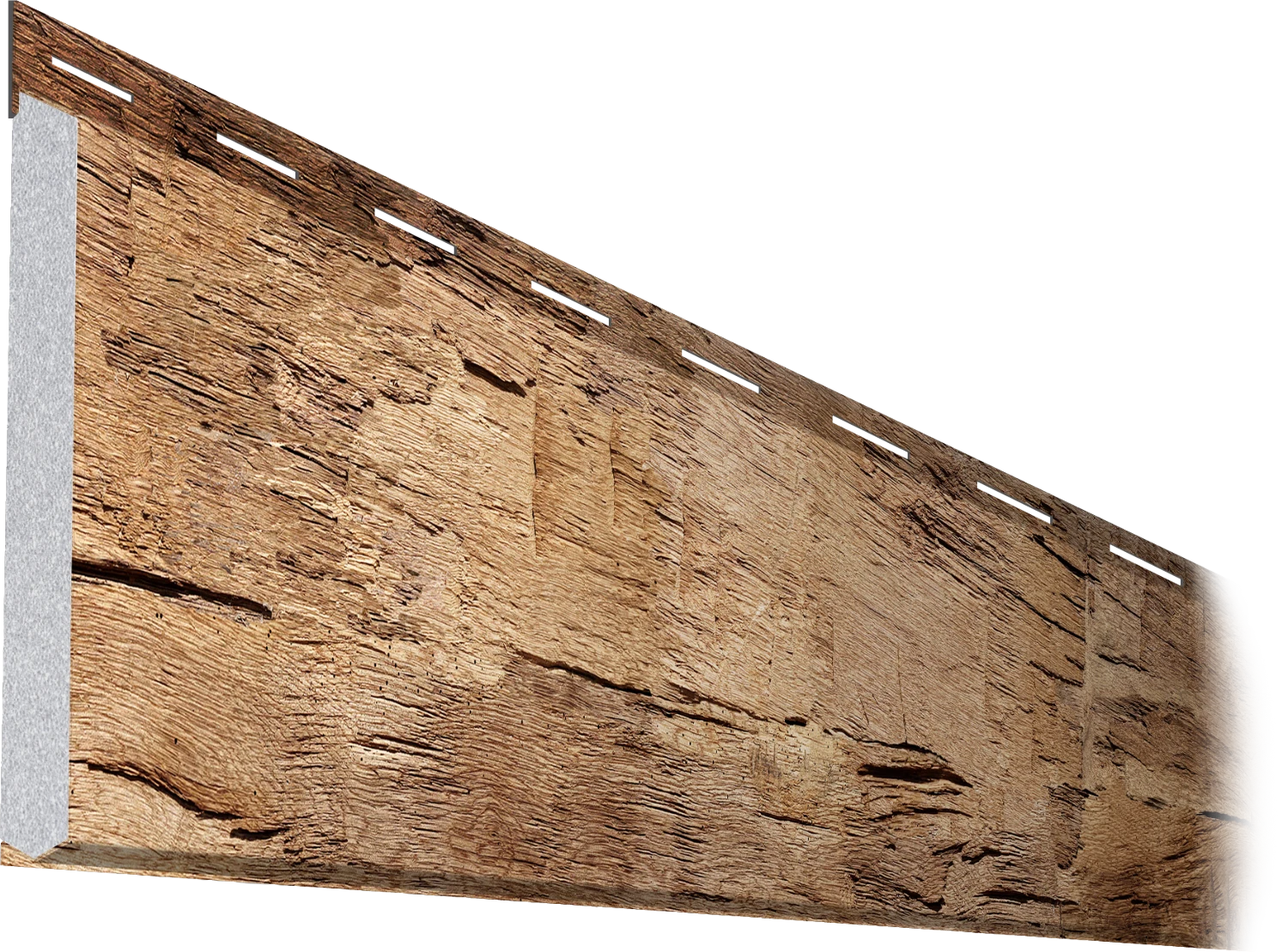
| Log Profile | Hand hewn log siding with chinking — 4 chinking colors |
| Warranty | 50-year peeling/flaking | 20-year fade/chalk |
| Panel | 10-inch planks, Slide-Lock system, one-person install |
| Base Coat | AZ55 Galvalume (zinc-aluminum alloy corrosion barrier) |
| Origin | New Philadelphia, Ohio — direct ship to all 49 states |
Hand Hewn Log Siding with Chinking in Ohio
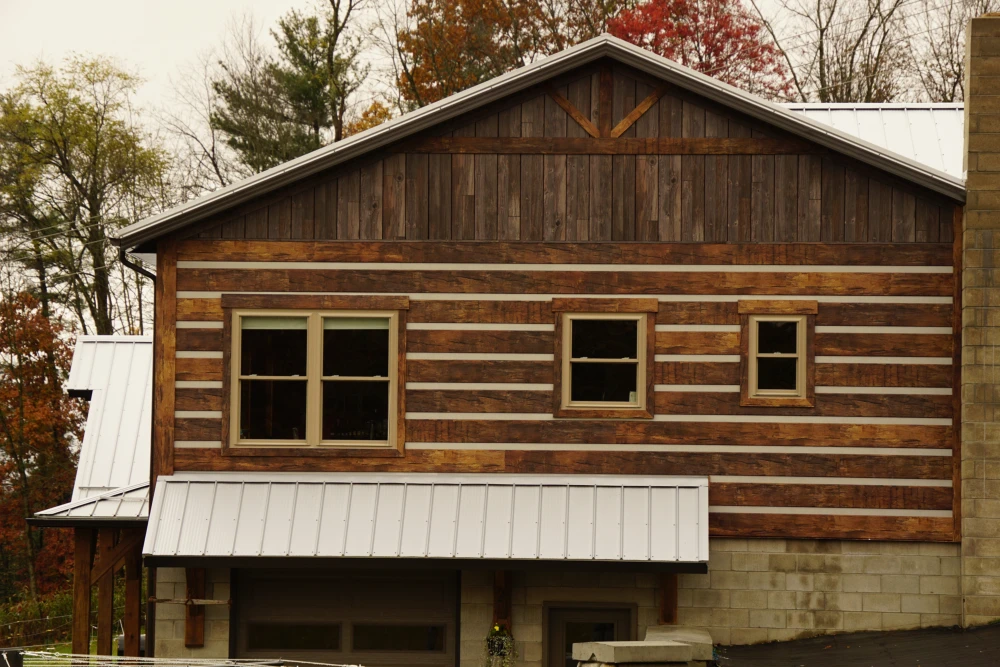
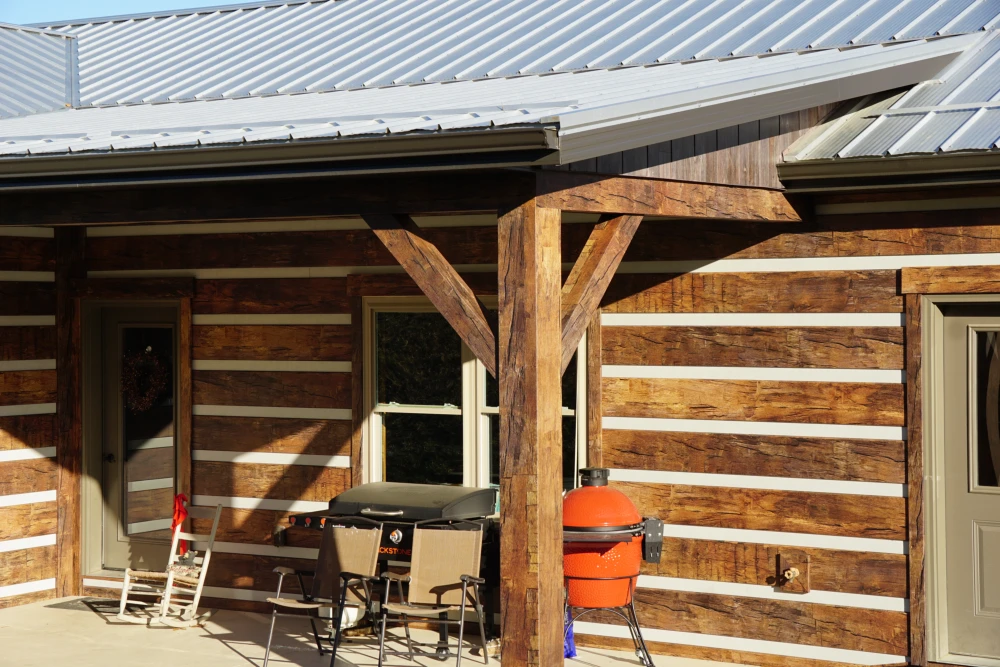
A lot of Ohio's rural counties and small towns are built around the log and farmhouse look. Vinyl can't replicate it. The log aesthetic runs strong through Holmes County, Wayne County, and the farming communities of the Muskingum Valley, and it shows up in the cottage construction along Buckeye Lake, Indian Lake, and the inland reservoirs, and in the Appalachian foothills of southeastern Ohio.
Hand hewn log siding with chinking in 26-gauge steel gives you that look with a material that's built for Ohio's climate and won't need the maintenance that real wood log siding requires. The hand hewn texture looks like actual milled log siding, with the same dimensional variation you'd see on real logs. Chinking comes in four colors: Ash Gray, Charcoal, Clay, and Sandstone Tan. From the street, it reads like a log home.
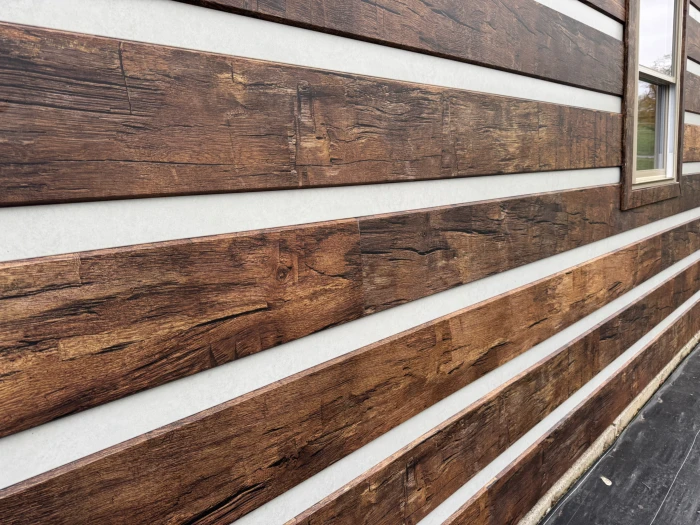
Ohio's humidity makes the steel version more practical than real wood log siding. Wood log siding in a humid climate absorbs moisture through the chinking joints and needs regular upkeep to keep it from rotting out over time. Steel doesn't have that problem. Hand hewn log siding with chinking in steel has nothing in it to absorb moisture, swell, or rot, and it holds its appearance without ongoing maintenance across Ohio's full climate.
SteeLuxe is the only steel siding company making hand hewn log siding with chinking. It ships from New Philadelphia, Ohio and is available in all 22 wood grain patterns in the SteeLuxe line, covering colors from weathered gray to warm cedar brown that fit most Ohio cabin and farmhouse applications.
Ready to Transform Your Home With Hand-Hewn Log Cabin Siding?
Get the authentic hand-hewn cabin look with the chinking detail you love, and never think about maintenance again. SteeLuxe steel siding is insulated, fire-rated, hail-resistant, and built to last a lifetime. See it and feel it for yourself.
Steel Siding vs the Alternatives in Ohio
Ohio is hard on siding, and every major material has a specific failure point in this climate.
Steel vs Vinyl
Vinyl's cold and hail problem shows up clearly in northeast Ohio. When temperatures fall below 20 degrees and then a hailstorm comes through, vinyl panels that are already stiff crack on impact instead of giving the way warmer vinyl would. Lake-effect freeze-thaw cycles compound the problem over time, stressing the nail-hem fastening system with every seasonal cycle. Vinyl that looks fine at year five is often showing loose panels and cracked seams by year twelve in the Cleveland area, and that timeline moves faster the further into the lake-effect belt you go.
Vinyl also has no real insulation and no impact rating that helps in Ohio's hail corridor. Insurance companies in high-hail Ohio zip codes are pricing that gap. Class 4-rated steel siding qualifies for premium discounts in those zip codes, and in the most active hail areas in Ohio, the savings can offset a meaningful part of the installation cost over a 10-year policy. That's a real number worth running before you finalize a material decision on a re-siding job in Columbus, Cincinnati, or any of the high-frequency hail areas in the southwest quarter of the state.
Steel vs Fiber Cement
Fiber cement handles cold better than vinyl, but it still has two real problems in Ohio. Five months of humidity pushes moisture into fiber cement panels at a rate that makes paint peel every 7 to 10 years, and that maintenance cost adds up significantly over the life of a siding installation that's supposed to last 40 years. Many homeowners don't realize they're signing up for that repaint cycle when they choose fiber cement. Hail is the second problem. Fiber cement chips and cracks under a severe Ohio hailstorm, and after a bad storm you're replacing panels, not just inspecting them and moving on.
Steel vs Wood
Wood siding in Ohio is fighting two things at once. Termites are active statewide, and wood gives them exactly what they need: food and moisture. Ohio's summer humidity makes paint and stain peel off wood faster than in drier states, usually needing a fresh coat every 4 to 6 years in the more humid southern part of the state. Steel eliminates both problems in the same material choice.
Frequently Asked Questions
Q:How long does SteeLuxe steel siding last in Ohio's climate?
Q:Is steel siding more expensive than vinyl or fiber cement?
Q:Does steel siding dent?
Q:Can steel siding be painted?
Q:Does lake-effect snow damage siding faster than regular winter weather?
Q:Do Ohio insurance carriers offer discounts for Class 4 impact-rated siding?
Q:Is termite-resistant siding worth specifying in Ohio?
Q:What Ohio cities does SteeLuxe serve?
Q:Why is SteeLuxe manufactured in Ohio?
Ohio Cities & Regions We Serve
SteeLuxe makes its panels in New Philadelphia, Ohio and ships them across the state. Being close to the work means faster delivery and easier access to the people who built the product when a job-specific question comes up.
Columbus is Ohio's biggest siding market. Cleveland, Akron, and the northeast Ohio corridor are the lake-effect zone, where cold winters and hail season both drive the siding decision. Cincinnati and the southwestern counties have the state's highest termite pressure and the most intense summer humidity. Toledo and northwest Ohio deal with the open cold that flat terrain makes worse. Holmes County, Wayne County, the lake cottage areas around Buckeye Lake, and the Appalachian foothills of southeastern Ohio are where hand hewn log siding with chinking fits best.
Start with five cities. Columbus, Cleveland, Cincinnati, Toledo, and Akron all have full city pages with local installer contacts, condition-specific data, and pricing for projects in that area. More Ohio cities across all 88 counties are in our database below:
Don't see your city listed here. Contact SteeLuxe directly, and someone who knows Ohio's regional conditions will help you find the nearest installer and get current pricing for your area.
Get a Quote for Steel Siding in Ohio
SteeLuxe is manufactured in New Philadelphia, Ohio and ships direct. Whether you are planning a full re-siding project or exploring options, we can get you pricing, color samples, and a list of installers in your area.