
Steel Siding & Hand Hewn Log Siding in North Carolina
Steel Siding in North Carolina
Steel siding in North Carolina answers for four conditions that shift in intensity across three very different regions. Freeze-thaw cycling runs hard in the western mountains and moderates through the Piedmont. Termite pressure is Very Heavy across the coastal plain and eastern counties, dropping to Heavy through the Piedmont and lighter in the mountains. Hurricane exposure reaches every county east of the Blue Ridge, with direct storm impacts along the Outer Banks and coastal plain. Salt air from the Atlantic affects siding year-round along the coast and well into the interior. Wood grain siding in the 22 patterns SteeLuxe manufactures covers the full North Carolina aesthetic, from the craftsman bungalows of Charlotte and Raleigh to the log and timber profile of the western mountain communities.
Freeze-thaw cycling in North Carolina runs at its most demanding in the western mountains, where Asheville averages a January low near 24 degrees and Boone, at 3,300 feet elevation, averages closer to 18 degrees. Mountain communities along the Blue Ridge cycle through the freezing mark from November through March. Charlotte and Raleigh average January lows around 32 degrees and cross the freezing mark through February. Along the coastal plain and Outer Banks, winters are mild enough that freeze-thaw cycling is a minor condition.
Termite pressure across North Carolina's eastern counties and coastal plain is Very Heavy, matching what applies across South Carolina, Georgia, and the Gulf Coast. Wilmington, the Outer Banks, and the coastal plain counties east of Raleigh sit in the state's most active termite territory. Pressure drops to Heavy through the Piedmont and Moderate to light in the western mountains. Wood siding anywhere in the state faces active termite pressure from the soil below it.
Hurricane exposure along North Carolina's coast is as concentrated as anywhere in the country. The Outer Banks jut far enough into the Atlantic that major storms make direct landfall there at a rate few other coastal regions match. Hurricanes and tropical storms making landfall carry sustained winds above the threshold for structural siding damage, and Piedmont communities from Raleigh west to Charlotte regularly receive tropical-storm-force winds from systems that track northwest after landfall.
Salt air from the Atlantic and the broad shallow water of the Pamlico and Albemarle sounds create a maritime environment that carries salt-laden moisture well inland. Communities within 50 to 100 miles of the coast, including the Raleigh metro, see meaningful salt air exposure year-round. Paint systems on wood and fiber cement in this environment degrade faster than the same materials in inland climates, shortening repainting cycles and accelerating surface failure at coastal and near-coastal addresses.
North Carolina's three main geographic regions each carry the conditions at different weights. Western mountains carry the strongest freeze-thaw cycling and the log and cabin market. The Piedmont carries the state's largest residential siding market. Coastal plain and Outer Banks carry the most intense hurricane, salt air, and termite conditions.
The Most Advanced Steel Siding On The Market
- 20 Year Fading & Chalking Warranty
- 50 Year Flaking & Peeling Warranty
- Lasts 40-60+ Years
- One Person Installation
Climate & Conditions Across North Carolina
North Carolina's geography stretches from the 6,684-foot summit of Mount Mitchell, the highest peak in the eastern United States, to the barrier islands of the Outer Banks sitting exposed in the Atlantic, and no two parts of the state face the same siding condition profile.
Charlotte and the Piedmont corridor from Greensboro and Winston-Salem through the Research Triangle of Raleigh, Durham, and Chapel Hill represent the state's largest residential siding market by a wide margin. The Piedmont sits in a moderate climate zone, with January lows averaging around 32 degrees in Charlotte and Raleigh and a freeze-thaw cycle that runs from December through February. Termite pressure across the Piedmont is Heavy, and the growing season for subterranean colonies is long. Hurricane-related wind and rain events reach the Piedmont from coastal storms multiple times per decade, and salt air exposure intensifies across the eastern Piedmont counties nearest the coast.
Wilmington and the coastal plain communities of Brunswick, New Hanover, Pender, and Onslow counties sit at the intersection of the state's most demanding conditions. Termite pressure is Very Heavy along the entire coastal plain. Salt air is a year-round condition from the Atlantic and the Intracoastal Waterway. Hurricane exposure is immediate, with Wilmington and the Cape Fear River area taking direct hits from multiple major hurricanes in the past 30 years. The Outer Banks communities face all of these conditions at their most intense: salt spray, sand-laden wind, direct hurricane landfall exposure, and Very Heavy termite pressure in the soil behind the dunes.
Asheville and the western mountain communities of Buncombe, Henderson, Haywood, and Jackson counties carry North Carolina's most demanding freeze-thaw cycling and the state's strongest market for the log and timber exterior profile. The Blue Ridge Parkway corridor from the Virginia border south through Boone, Blowing Rock, Newland, and Banner Elk draws year-round residents and a dense second-home and vacation rental market. Brevard, Waynesville, and the communities of the Nantahala and Pisgah national forest corridors extend the cabin and mountain residential market into the southwestern corner of the state. Termite pressure in the western mountains is Moderate and limited by the colder winters.
The Research Triangle communities of Raleigh, Durham, Chapel Hill, and Cary, along with the fast-growing suburban ring, represent the state's second-largest residential siding market and a fast-growing major metro in the Southeast. Termite pressure here is Heavy, with active colony season running from March through November. Salt air exposure is meaningful given the Triangle's proximity to the coast. The Triangle also sits in the path of tropical systems that make landfall on the Cape Fear coast and the Outer Banks and track northwest, bringing sustained wind and heavy rain across the metro multiple times per decade.
Need help finding an installer?
Why Steel Siding Is Right for North Carolina
Four conditions shape the siding specification across North Carolina's three regions. Each has a documented failure pattern in the materials most North Carolina homes currently carry, and each has a direct answer in 26-gauge steel.
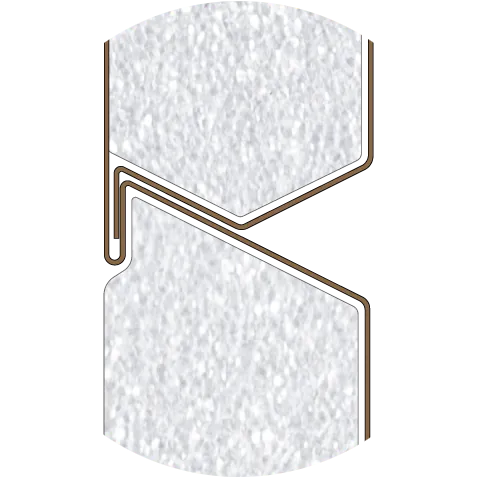
Freeze-thaw cycling in the western mountains is the most demanding in the state, and steel answers it directly. Steel doesn't absorb moisture, so there's nothing inside the panel to freeze, expand, and crack when temperatures drop to 18 degrees in Boone or 24 in Asheville and rise again across a freeze-thaw season that runs from November through March. The Slide-Lock panel system handles the dimensional changes temperature swings produce in the steel without creating gaps or pulling fasteners loose. Wood opens at joints through repeated moisture cycling, and vinyl goes brittle at temperatures well above the lows the mountain communities regularly see.
Termite pressure at Very Heavy across the coastal plain and Heavy through the Piedmont makes wood siding a permanent liability at every North Carolina address east of the Blue Ridge. Subterranean colonies are active from March through November, a season three to four months longer than in the northern states. Steel siding gives termites nothing to eat: no wood content in the panel and no moisture pathway a colony can work at the wall level. That protection holds for the full 40 to 60-year life of the installation without retreatment.
Hurricane and tropical storm wind across the coastal plain and Outer Banks puts structural performance ahead of aesthetics on every siding specification. The Slide-Lock panel-to-panel connection holds under lateral wind load rather than depending on a nail hem that can pull free under sustained high wind. Class 4 impact resistance handles wind-driven debris at energy levels that crack and puncture vinyl. The difference between a mechanically interlocked panel and a hung panel in a Category 1 or 2 wind event is the difference between siding that stays on the building and siding that peels off in strips.
Salt air along the coast and well into the coastal plain accelerates paint failure on wood and surface degradation on fiber cement. Steel siding's AZ55 Galvalume base coat is a zinc-aluminum alloy bonded to the steel at the manufacturing stage, providing corrosion resistance that doesn't depend on paint staying intact. At coastal addresses where paint on wood lasts half as long as expected, the AZ55 base coat continues performing without retreatment.
Product Specifications
| Spec | Value |
|---|---|
| Gauge | 26-gauge steel (~25% thicker than 29-gauge) |
| Core | EPS foam, R-3.57 continuous insulation value |
| Fire Rating | Class A (highest available) |
| Impact Rating | Class 4 (highest available) |
| Colors | 50 solid colors (Sherwin Williams WeatherXL) |
| Wood Grain | 22 patterns (Kynar 500 resin) |
| Log Profile | Hand hewn log siding with chinking — 4 chinking colors |
| Warranty | 50-year peeling/flaking | 20-year fade/chalk |
| Panel | 10-inch planks, Slide-Lock system, one-person install |
| Base Coat | AZ55 Galvalume (zinc-aluminum alloy corrosion barrier) |
| Origin | New Philadelphia, Ohio — direct ship to all 49 states |
Hand Hewn Log Siding with Chinking
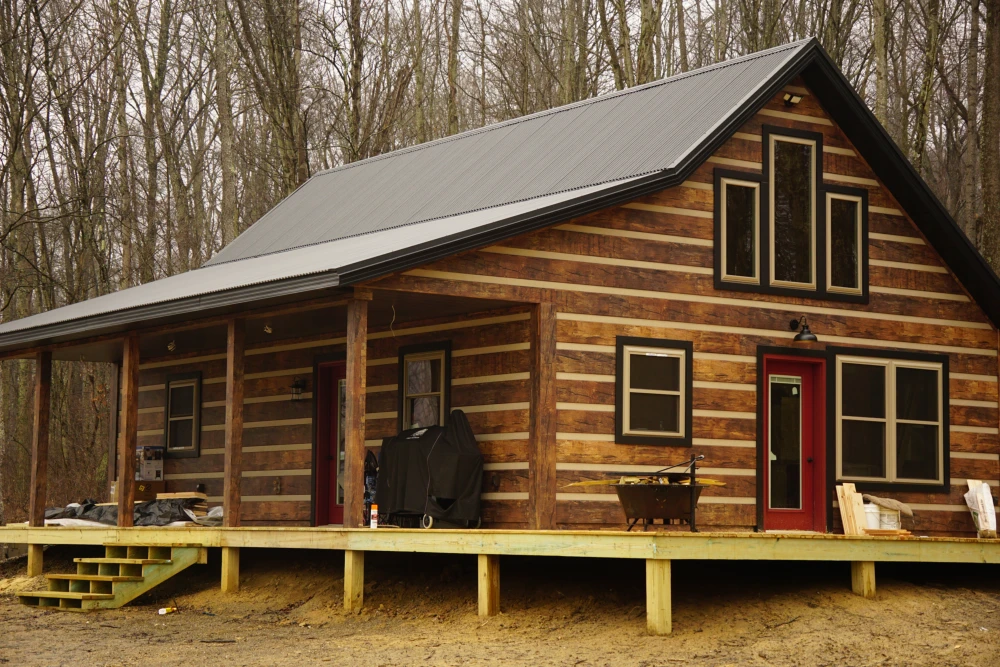
Western North Carolina carries the state's strongest market for the log and timber exterior profile. Cabins, vacation rentals, mountain retreats, and year-round properties from Asheville north through Boone, Blowing Rock, and the Blue Ridge Parkway corridor to the Virginia border represent a market where the hand hewn log profile is the defining aesthetic for the property type. New mountain construction follows it, and buyers entering the western mountain market expect to see it.
Real wood log siding in the western mountains faces the same failure cycle as anywhere freeze-thaw runs hard. Moisture works into log joints through the wet autumn and spring shoulder seasons, and freeze cycles reaching into the teens in Boone and the low 20s in Asheville crack those joints and open surfaces to repeated freeze-thaw damage. The maintenance window for exterior work at mountain cabin properties is short, competing with the summer rental season owners depend on.
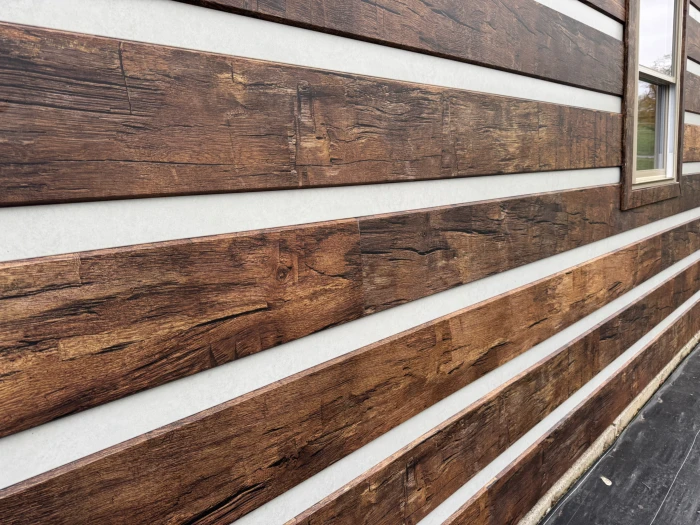
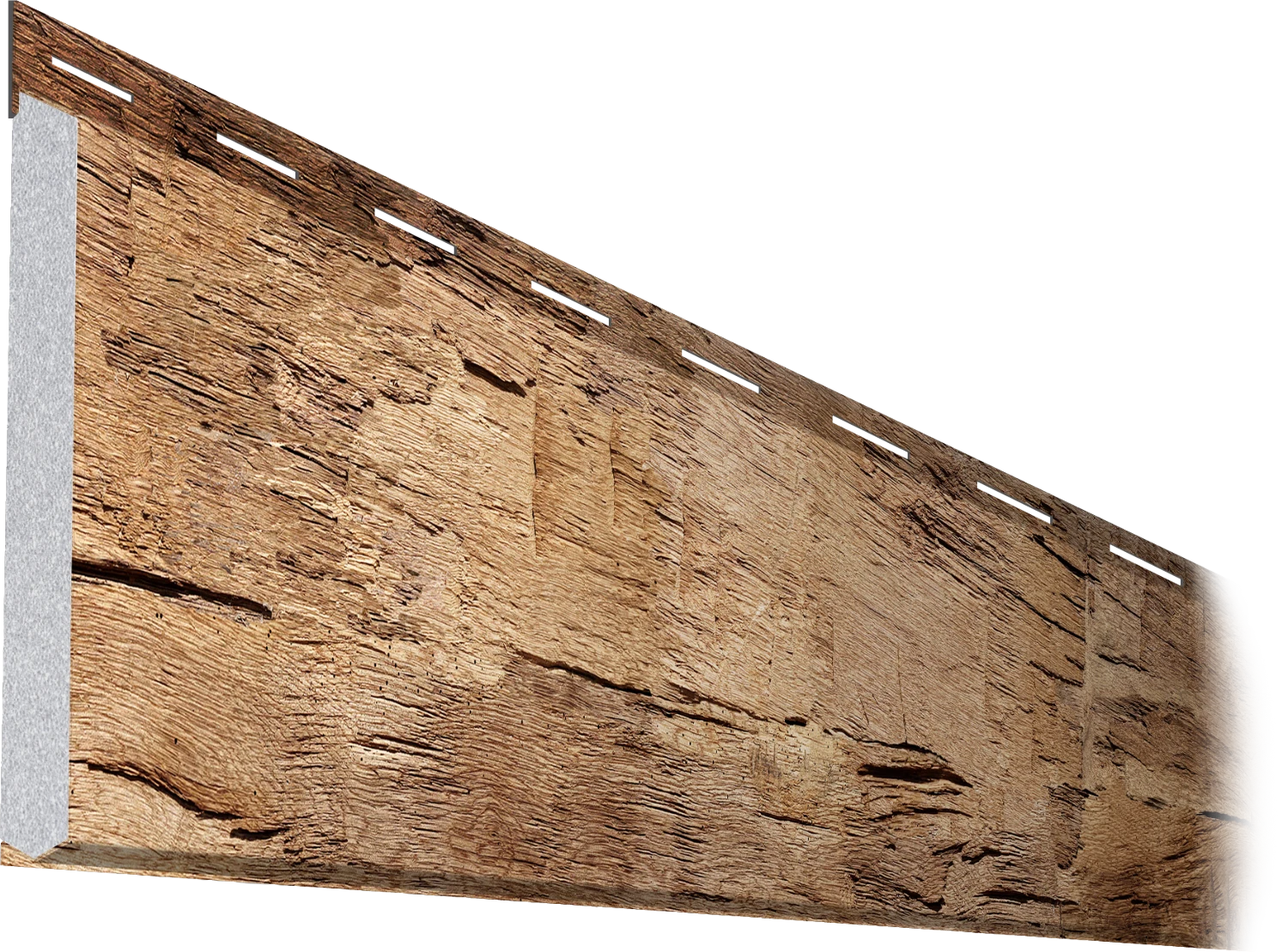
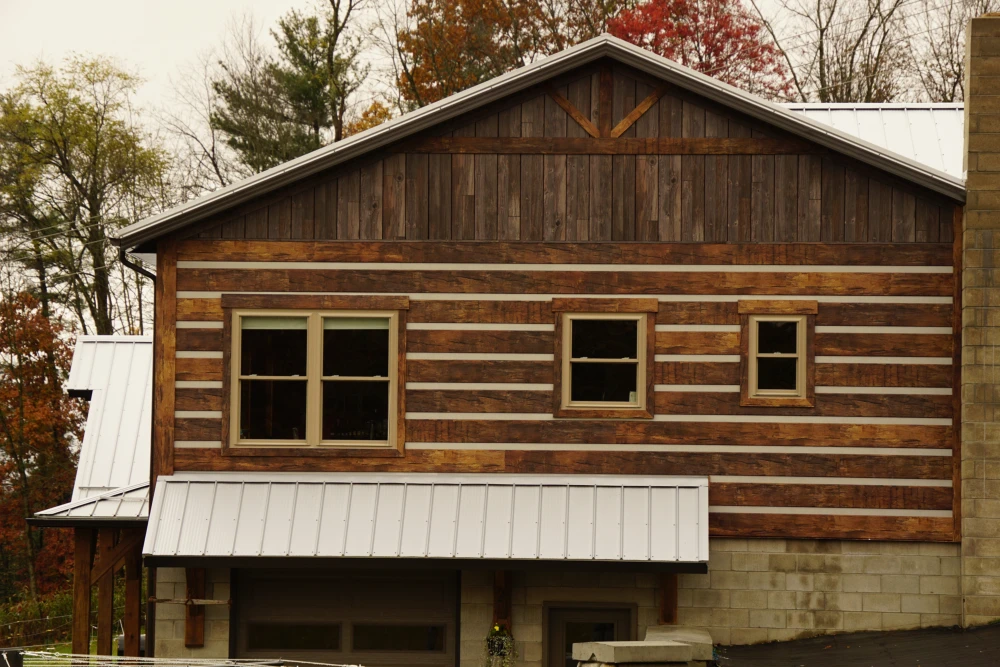
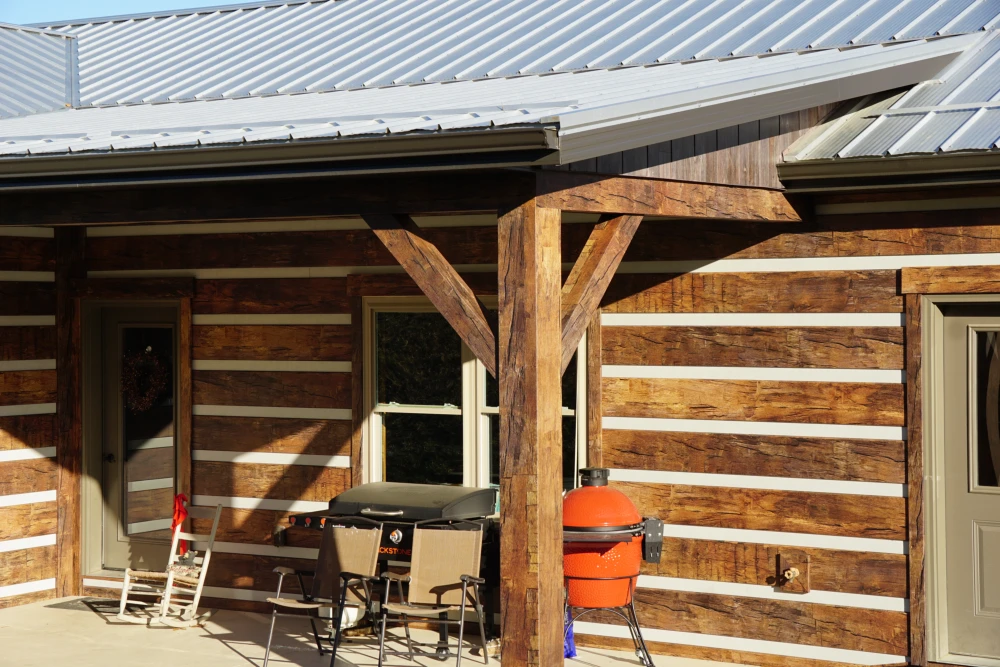
Hand hewn log siding with chinking in 26-gauge steel delivers the western North Carolina cabin aesthetic without those failure modes. Steel doesn't absorb moisture, so the freeze-thaw cycle that splits wood grain at log joints has nothing to act on. The hand hewn surface replicates the texture and dimensional variation of actual milled log siding. Chinking fills the joints in four colors: Ash Gray, Charcoal, Clay, and Sandstone Tan. From the road, it reads as traditional log construction.
SteeLuxe is the only manufacturer making hand hewn log siding with chinking in steel. It ships direct from New Philadelphia, Ohio to cabins, vacation rentals, and year-round homes throughout western North Carolina's mountain communities, available across all 22 wood grain patterns in the SteeLuxe line.
Ready to Transform Your Home With Hand-Hewn Log Cabin Siding?
Get the authentic hand-hewn cabin look with the chinking detail you love, and never think about maintenance again. SteeLuxe steel siding is insulated, fire-rated, hail-resistant, and built to last a lifetime. See it and feel it for yourself.
Steel Siding vs the Alternatives
North Carolina's termite and hurricane combination gives each of the three most common siding alternatives a specific failure case. Steel addresses all four active conditions in a single panel. Each alternative answers some conditions and falls short on others.
Vinyl is the most common replacement siding on North Carolina homes over the past 40 years, and it has specific failure modes at both ends of the state. In the western mountains, it goes brittle at temperatures well above the lows that Boone and the higher mountain communities regularly record. Along the coast, vinyl has no meaningful wind resistance under hurricane conditions: a Slide-Lock steel panel holds mechanically to the course below it, while vinyl siding hung on a nail hem can peel free under sustained wind. Termites treat vinyl indifferently, meaning vinyl doesn't prevent subterranean colony activity at the foundation level and the wood framing behind the vinyl remains accessible to termite pressure from the foundation.
Fiber cement carries a Class A fire rating and handles cold better than vinyl, making it a credible option in the Piedmont's moderate climate. Its main North Carolina liabilities are moisture at the coast and termites at every address. Moisture absorption at cut edges is fiber cement's consistent weakness, and North Carolina's coastal climate, with its high humidity, salt air, and frequent rainfall, works moisture into cut edges at penetrations and trim faster than the product's rated performance. Factory paint on fiber cement requires repainting on a 10 to 15-year cycle. In the coastal plain humidity, repainting is needed on the most exposed elevations before the 10-year mark. Fiber cement has no Class 4 impact resistance option.
Wood siding is the appropriate original material on North Carolina's historic homes in the older neighborhoods of Charlotte, Raleigh, Asheville, and the coastal towns like Wilmington, New Bern, and Beaufort, and historic district guidelines in many of those neighborhoods require it. The maintenance burden in North Carolina's climate is the argument wood can't win. Paint on wood in the coastal plain fails in 4 to 6 years from humidity, salt air, and UV. Termites at Very Heavy pressure in the east treat wood siding as a permanent food source at every coastal address. Over a 30-year period, the cumulative maintenance cost is the case for a better material.
Frequently Asked Questions
Q:What makes SteeLuxe steel siding different from other steel siding products?
Q:How does the Slide-Lock installation system work?
Q:What wood grain patterns are available?
Q:Does steel siding rust?
Q:How does steel siding perform in hurricane conditions?
Q:How does North Carolina's termite pressure affect siding choice?
Q:Does salt air affect steel siding differently than wood or fiber cement?
Q:Does SteeLuxe install in my city?
Q:Does the log siding profile work on a western North Carolina mountain cabin?
North Carolina Cities & Regions We Serve
SteeLuxe ships from New Philadelphia, Ohio to residential, cabin, and contractor projects across all 100 North Carolina counties, with lead times that work for both the year-round Piedmont markets and the seasonal construction calendar of the western mountain communities.
Charlotte and the Piedmont communities of Concord, Gastonia, Monroe, and Kannapolis, along with the surrounding counties of Mecklenburg, Union, Cabarrus, and Gaston, represent the state's largest residential siding market. Re-siding activity here runs year-round, driven by the aging suburban housing stock and the Heavy termite pressure active through the long southern growing season.
Raleigh, Durham, Chapel Hill, Cary, and the fast-growing communities of Wake, Durham, Orange, and Johnston counties represent the state's second-largest metro siding market. Termite pressure is Heavy and the active season is long. Salt air exposure from the nearby coast is a meaningful factor in the eastern Wake County communities.
Wilmington and the coastal communities of Brunswick, Pender, and Onslow counties, along with the Outer Banks communities of Dare and Currituck counties, carry the state's most demanding combination of conditions: Very Heavy termite pressure, direct hurricane exposure, and year-round salt air. Re-siding projects in this corridor increasingly specify Class A-rated and impact-resistant materials.
Asheville, Boone, Blowing Rock, Brevard, Waynesville, and the communities of the Blue Ridge Parkway and Pisgah and Nantahala national forest corridors make up the state's strongest second-home and cabin siding market. Freeze-thaw cycling here is the most demanding in the state, and the log and timber exterior profile defines the residential aesthetic.
Full city pages with local installer contacts and current pricing are available for Charlotte, NC. More North Carolina cities are listed below:
Don't see your city listed here. Contact SteeLuxe directly and someone familiar with North Carolina's regional conditions will point you to the nearest installer and current pricing for your area.
Get a Quote for Steel Siding in North Carolina
SteeLuxe is manufactured in New Philadelphia, Ohio and ships direct. Whether you are planning a full re-siding project or exploring options, we can get you pricing, color samples, and a list of installers in your area.