
Steel Siding & Hand Hewn Log Siding in New Hampshire
Steel Siding in New Hampshire
Steel siding in New Hampshire answers for four conditions, with cold setting the standard for what exterior materials have to perform through statewide. Concord averages a January low near 9 degrees, Manchester near 11, and the North Country communities near or below zero. Hail is a seasonal risk across the southern half of the state. The short coastal stretch from Hampton Beach to Portsmouth carries direct hurricane exposure and salt air. Wood grain siding in the 22 patterns SteeLuxe manufactures covers New Hampshire's full range, from the colonial and craftsman profiles of the Manchester and Nashua metro to the cabin and mountain profiles of the Lakes Region and White Mountains.
Freeze-thaw cycling in New Hampshire runs from October through April in the north and November through March in the south. Concord averages a January low near 9 degrees and crosses the freezing mark repeatedly through the shoulder months. Berlin and the North Country average near zero in January and record stretches below minus 20. Elevation compounds the cold in the White Mountains: properties above 2,000 feet face temperature profiles matching Vermont and northern Maine, with the freeze-thaw season extending well into April.
Hail across New Hampshire is a real but secondary condition. The southern communities from Nashua and Manchester through Concord and the Merrimack Valley see the most consistent hail activity, carried by the same storm track that produces hail across southern New England. Northern New Hampshire, including the White Mountains and the North Country, sees significantly less hail than the south. The condition doesn't drive the specification the way cold does, but it's a real seasonal risk across the populated southern half of the state.
New Hampshire's coastline runs only 18 miles, the shortest ocean frontage of any coastal state in the country, but the communities along that stretch, including Hampton Beach, Seabrook, Rye, and Portsmouth, face direct hurricane and tropical storm exposure and persistent salt air from sustained ocean exposure. Salt air at the New Hampshire seacoast is concentrated along the coastal strip and the lower Piscataqua River corridor, reaching a few miles inland from the shore.
New Hampshire's Lakes Region and White Mountains together carry a second-home and cabin market that rivals any in New England. Lake Winnipesaukee, Squam Lake, and Lake Sunapee represent a dense concentration of seasonal and year-round lake properties. North Conway, Jackson, and Franconia anchor the White Mountains ski and vacation corridor. Exterior materials at unattended mountain and lake properties face a New Hampshire winter as demanding as any second-home market in the Northeast.
New Hampshire's three main condition zones each carry the four conditions at different intensities. Seacoast and Portsmouth communities carry the most active hurricane and salt air exposure. Southern communities from Nashua through Concord carry the most active hail season. The White Mountains and North Country carry the state's most severe cold and the longest freeze-thaw season.
The Most Advanced Steel Siding On The Market
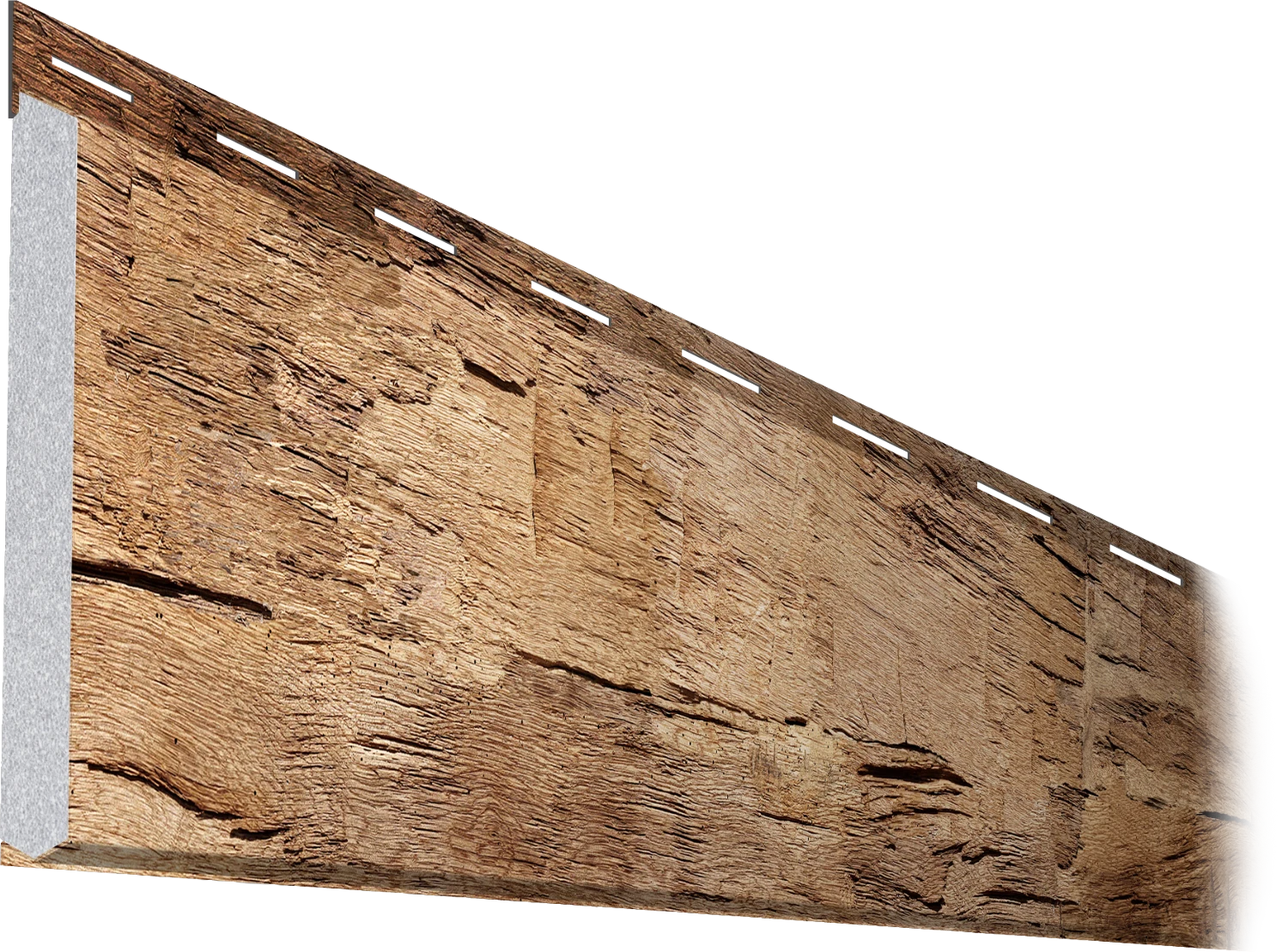
- 20 Year Fading & Chalking Warranty
- 50 Year Flaking & Peeling Warranty
- Lasts 40-60+ Years
- One Person Installation

Climate & Conditions Across New Hampshire
New Hampshire's geography runs from the ocean to the summit of Mount Washington in fewer than 100 miles, and the four conditions active in the state distribute across that gradient in ways that create meaningfully different siding specifications from one region to the next.
Manchester and the southern New Hampshire communities of Nashua, Salem, Derry, and the surrounding Hillsborough and Rockingham county corridors represent the state's largest residential siding market. The city averages a January low near 11 degrees, and the southern tier's freeze-thaw season runs from November through March with shoulder-month cycling that works exterior materials on every exposed elevation. Hail is more active in southern New Hampshire than in the rest of the state, carried by storm tracks through the Merrimack Valley. The Manchester and Nashua metro represents New Hampshire's most active year-round siding market, driven by a large stock of aging New England housing.
Concord and the surrounding Merrimack County communities represent the state's capital region and the gateway to the Lakes Region market. The capital averages a January low near 9 degrees and sits at the transition between the state's southern market and the more severe climate of the central and northern communities. Lake Winnipesaukee and the surrounding Laconia and Meredith communities form a concentrated high-value second-home market that drives significant siding activity on both new construction and existing camp and cabin renovations.
Portsmouth and the seacoast communities of Hampton, Hampton Beach, Seabrook, Rye, and Exeter represent New Hampshire's coastal market, where salt air and hurricane exposure add two conditions to the freeze-thaw baseline that applies statewide. The city is a historic port with a significant stock of 19th and early 20th century residential buildings, many of which face the full salt air and freeze-thaw combination on their seaward elevations. Seacoast communities from Hampton Beach to the Maine border sit in the direct path of Atlantic storms that reach the New Hampshire shore before they weaken over land.
North Conway and the White Mountains communities of Jackson, Bartlett, Gorham, and the surrounding Carroll and Coos county areas carry New Hampshire's most extreme cold and the state's most active second-home and vacation property market outside the Lakes Region. The town, at the head of the Mount Washington Valley, averages a January low near 5 degrees and regularly records stretches below zero in hard winters, serving as the commercial and residential center for the White Mountains tourism and ski market. Berlin and the North Country communities of Coos County carry the state's most severe cold, with January lows near or below zero and a freeze-thaw season that runs from October through April.
Need help finding an installer?
Why Steel Siding Is Right for New Hampshire
Four conditions are active across New Hampshire, and cold is the one that sets the specification for every address in the state. Each of the four has a direct answer in 26-gauge steel.
Steel addresses New Hampshire's cold more directly than any other siding material, because it doesn't absorb moisture and gives freeze-thaw cycling nothing to act on when temperatures drop to 9 degrees in Concord or below zero in Berlin and then cycle back above freezing through the long shoulder months. The Slide-Lock panel system handles the dimensional changes New Hampshire's temperature swings produce without creating gaps at joints or pulling fasteners loose. Vinyl goes brittle at temperatures New Hampshire delivers routinely through December, January, and February, reaching its failure threshold well before the coldest weeks arrive.
Elevation compounds the freeze-thaw severity at White Mountains and Lakes Region properties. A cabin in the Mount Washington Valley or above 2,000 feet in the White Mountains faces a freeze-thaw season that extends from October through April and temperature lows that vinyl cannot handle without cracking at fastener points and panel edges. Steel at those elevations performs the same way it performs in a Manchester suburb, because the material's behavior doesn't change as temperatures fall. The unattended winter is the defining performance test for mountain and lake properties, and steel passes it without maintenance.
Salt air and hurricane exposure at the New Hampshire seacoast require a material that resists corrosion at the base level, not as a surface treatment that degrades over time. The AZ55 Galvalume base coat bonds corrosion resistance into the steel core at the manufacturing stage. No amount of storm-driven salt spray, standing moisture, or freeze-thaw cycling removes that protection. For seacoast communities where tropical storms reach the shoreline before weakening over land, Class 4 impact resistance provides meaningful protection against wind-driven debris that a standard siding panel cannot match.
Hail across southern New Hampshire puts Class 4 impact resistance on the practical specification for Manchester, Nashua, and Concord addresses. The storm track through the Merrimack Valley produces hail seasons consistent enough that many New Hampshire insurance carriers apply a premium discount for Class 4-rated exterior products. It's not the dominant condition here, but it's a real one, and Class 4 comes standard on every SteeLuxe panel at no separate upgrade cost.
Product Specifications
| Spec | Value |
|---|---|
| Gauge | 26-gauge steel (~25% thicker than 29-gauge) |
| Core | EPS foam, R-3.57 continuous insulation value |
| Fire Rating | Class A (highest available) |
| Impact Rating | Class 4 (highest available) |
| Colors | 50 solid colors (Sherwin Williams WeatherXL) |
| Wood Grain | 22 patterns (Kynar 500 resin) |
| Log Profile | Hand hewn log siding with chinking — 4 chinking colors |
| Warranty | 50-year peeling/flaking | 20-year fade/chalk |
| Panel | 10-inch planks, Slide-Lock system, one-person install |
| Base Coat | AZ55 Galvalume (zinc-aluminum alloy corrosion barrier) |
| Origin | New Philadelphia, Ohio — direct ship to all 49 states |
Hand Hewn Log Siding with Chinking
New Hampshire's Lakes Region and White Mountains carry a second-home and cabin market that rivals any in New England. Lake Winnipesaukee carries thousands of lake properties, and the North Conway and Franconia corridors add mountain cabins, chalets, and lodges. These properties carry the log and cabin profile that fits the New Hampshire mountain aesthetic, and the performance demands through an unattended winter are severe.
Real wood log siding at a Winnipesaukee camp, a White Mountains chalet, or a Squam Lake property faces the same failure cycle as wood anywhere in the state. Moisture works into log joints through the wet shoulder seasons, and freeze cycles below zero crack those joints and open surfaces to repeated freeze-thaw damage. A property closed in November and reopened in May absorbs the full New Hampshire winter before anyone arrives to find a failure.
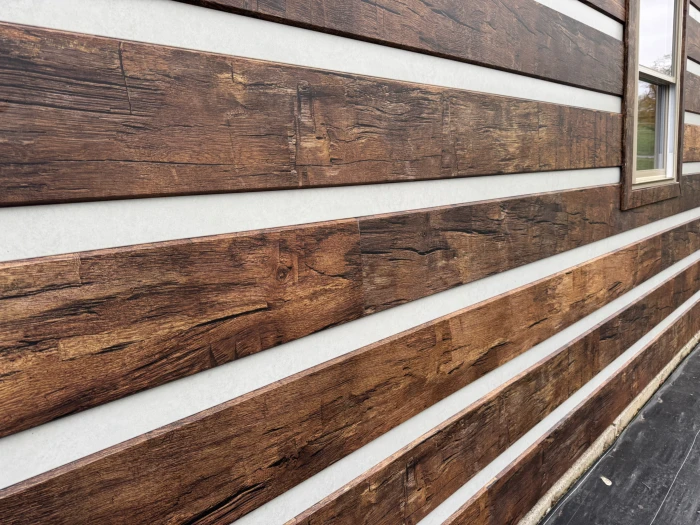
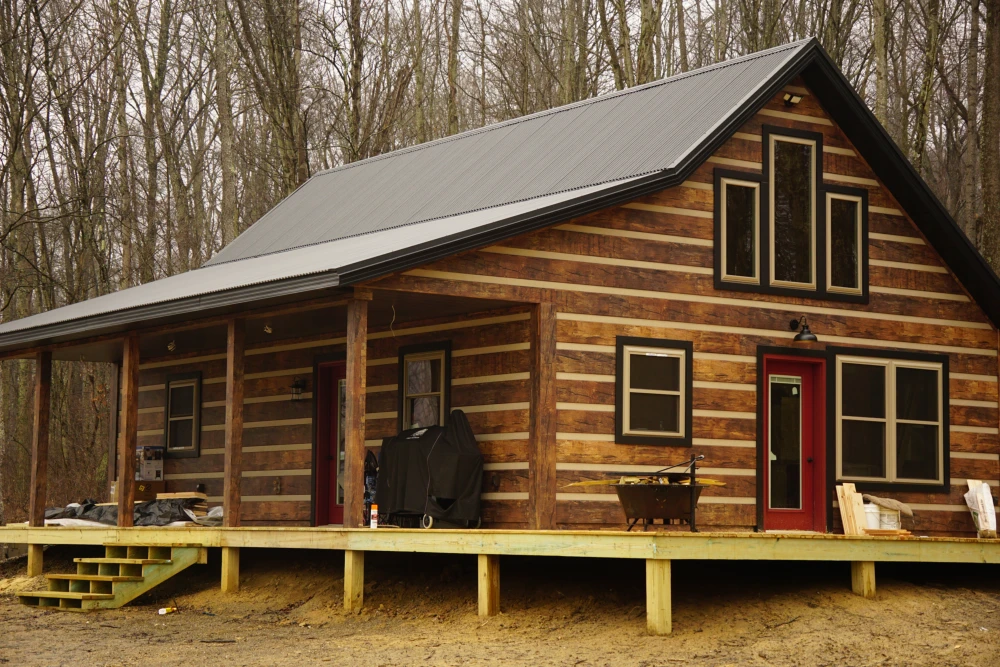
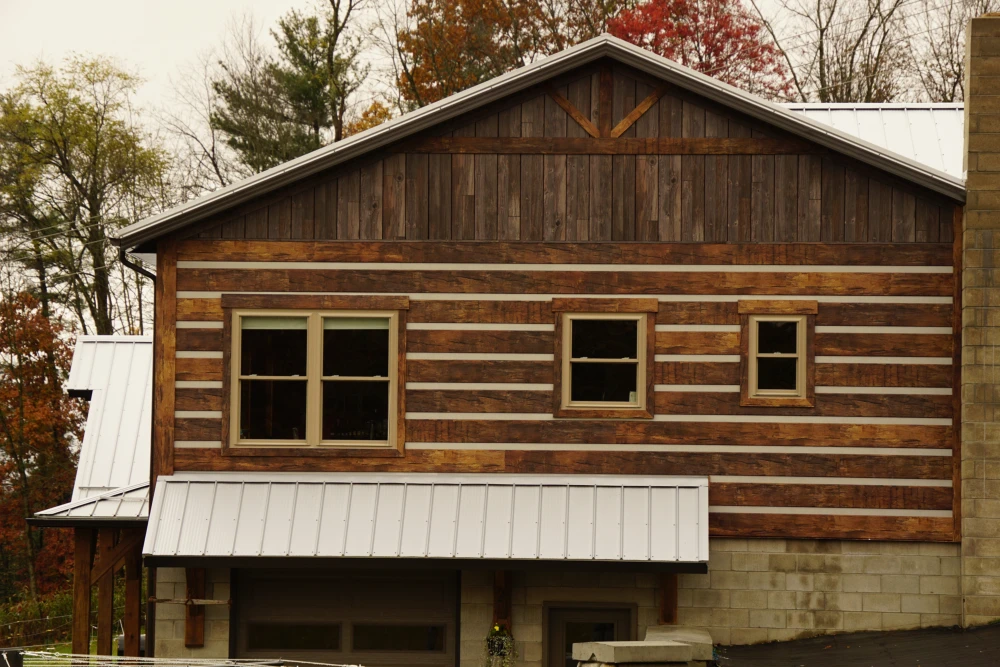
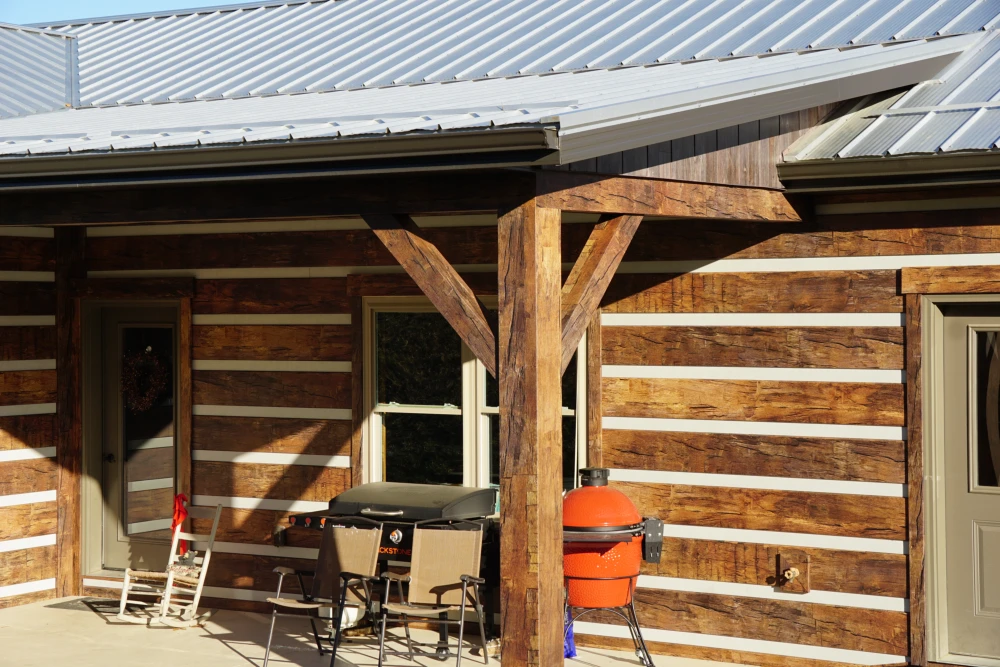
Hand hewn log siding with chinking in 26-gauge steel delivers the New Hampshire lake and mountain cabin aesthetic without those failure modes. Steel doesn't absorb moisture, so the freeze-thaw cycle that splits wood grain at log joints has nothing to act on. The hand hewn surface replicates the texture and dimensional variation of actual milled log siding. Chinking fills the joints in four colors: Ash Gray, Charcoal, Clay, and Sandstone Tan. From the road, it reads as traditional log construction.
SteeLuxe is the only manufacturer making hand hewn log siding with chinking in steel. It ships direct from New Philadelphia, Ohio to lake camps, mountain cabins, ski chalets, and year-round homes throughout New Hampshire's Lakes Region and White Mountains corridors, available across all 22 wood grain patterns in the SteeLuxe line.
Ready to Transform Your Home With Hand-Hewn Log Cabin Siding?
Get the authentic hand-hewn cabin look with the chinking detail you love, and never think about maintenance again. SteeLuxe steel siding is insulated, fire-rated, hail-resistant, and built to last a lifetime. See it and feel it for yourself.
Steel Siding vs the Alternatives
New Hampshire's cold, hail, hurricane exposure, and salt air test the three most common siding alternatives against a specification that requires real performance across four distinct conditions. Steel answers all four. Each alternative falls short on at least two.
Vinyl is the most common replacement siding on New Hampshire homes, and the state's climate exposes its two most consistent failure modes. Cold is the first: vinyl loses polymer flexibility at temperatures New Hampshire delivers for weeks at a time through January and February, and brittle vinyl cracks at fastener points and panel edges under thermal stress and wind load. Hail is the second: a hailstone that leaves no mark on a Class 4-rated steel panel cracks or punctures vinyl at the same impact energy, and cracked vinyl requires full-course replacement to restore a sealed installation. At seacoast addresses, salt air has no meaningful effect on steel but accelerates paint degradation on vinyl over time.
Fiber cement handles cold better than vinyl and carries a Class A fire rating, but it has three specific liabilities in New Hampshire: moisture absorption at cut edges, no rated hail protection, and a paint cycle that the freeze-thaw climate shortens. Moisture absorption is fiber cement's consistent weakness in hard freeze-thaw climates: cut edges at penetrations, trim joints, and windowsills absorb moisture through the wet shoulder seasons, and New Hampshire's deep freeze cycles work that moisture through dozens of hard freezes per season. Edge cracking and surface separation develop well before the product reaches the end of its warranty period. It also carries no Class 4 impact resistance option in standard product lines, leaving southern New Hampshire installations without rated hail protection.
Wood siding on New Hampshire homes faces a maintenance burden that the climate makes both expensive and predictable. Paint on wood in New Hampshire's freeze-thaw environment fails in 5 to 8 years, and each repainting cycle on an exposed New England home is a significant cost. Salt air and moisture at seacoast addresses shorten the paint cycle further. At mountain and lake properties, the unattended winter means paint failures and moisture intrusion go undetected for months. Steel ends the repainting cycle and holds its coating through New Hampshire's full weather range without attention.
Frequently Asked Questions
Q:What makes SteeLuxe steel siding different from other steel siding products?
Q:How does the Slide-Lock installation system work?
Q:What wood grain patterns are available?
Q:Does steel siding rust?
Q:How does New Hampshire's cold affect siding materials?
Q:Is steel siding appropriate for New Hampshire's seacoast communities?
Q:What happens to vinyl siding in a New Hampshire winter?
Q:Does SteeLuxe install in my city?
Q:Is steel siding worth it for a New Hampshire lake or mountain cabin?
New Hampshire Cities & Regions We Serve
SteeLuxe ships from New Philadelphia, Ohio to residential, cabin, and contractor projects across all ten New Hampshire counties, with lead times that work for both the year-round Manchester and Nashua markets and the seasonal construction windows of the Lakes Region and White Mountains.
Manchester, Nashua, Salem, Derry, and the communities of Hillsborough and Rockingham counties represent New Hampshire's largest residential siding market. The southern tier's combination of aging New England housing stock, active hail seasons, and cold winters drives year-round re-siding activity, with the Manchester metro leading the state in total installation volume.
Concord, Laconia, Franklin, Meredith, and the communities of Merrimack and Belknap counties represent the capital region and the gateway to the Lakes Region. Lake Winnipesaukee's high-value property market drives significant siding activity on both new construction and renovation, and the Concord area carries a strong year-round residential market driven by state government and the central New Hampshire economy.
Portsmouth, Hampton, Hampton Beach, Rye, and Exeter represent New Hampshire's coastal market, where salt air and hurricane exposure add two conditions to the freeze-thaw baseline. Portsmouth's stock of historic 19th and early 20th century residential buildings represents a concentrated renovation market, and the Hampton Beach corridor carries active seasonal and year-round residential re-siding activity.
North Conway, Jackson, Bartlett, Gorham, and Berlin represent New Hampshire's mountain and North Country market, where cold severity drives the specification and the second-home and vacation property market drives volume. Re-siding activity in this corridor runs on the shoulder-season construction calendar, with most installation work concentrated in May through October.
Full city pages with local installer contacts and current pricing are available for Manchester, NH. More New Hampshire cities are listed below:
Don't see your city listed here. Contact SteeLuxe directly and someone familiar with New Hampshire's regional conditions will point you to the nearest installer and current pricing for your area.
Get a Quote for Steel Siding in New Hampshire
SteeLuxe is manufactured in New Philadelphia, Ohio and ships direct. Whether you are planning a full re-siding project or exploring options, we can get you pricing, color samples, and a list of installers in your area.