
Steel Siding & Hand Hewn Log Siding in Maine
Steel Siding in Maine
Steel siding in Maine faces two conditions that run hard statewide. Cold winters are the first: Maine runs the coldest winters of any contiguous Atlantic state, with interior temperatures reaching minus 20 degrees and a freeze-thaw season spanning October through April at higher elevations. Salt air is the second: Maine's coastline is the longest of any Atlantic state south of Alaska, and marine air off the coast affects exterior materials far inland through river valleys and tidal reaches. The AZ55 Galvalume base coat builds corrosion resistance into the steel core rather than applying it as a surface coat that salt air gradually penetrates, and steel doesn't absorb moisture, removing the mechanism that drives freeze-thaw damage. Wood grain siding in the 22 patterns SteeLuxe manufactures covers the full Maine aesthetic, from Portland's painted clapboard to the log and timber profile of Maine's lake camps and mountain retreats.
Freeze-thaw cycling applies at every Maine address, from Portland's January low of around 12 degrees to Caribou in Aroostook County, which averages below zero in January and records lows below minus 25 in hard winters. The cycling through October and November and again through March and April, when temperatures cross the freezing mark repeatedly in a single week, is the most damaging phase for any material that absorbs moisture. Vinyl goes brittle below 20 degrees, and wood opens at joints through each absorption-and-release cycle. Steel doesn't absorb moisture, so freeze-thaw cycles have nothing to act on.
Atlantic coast and nor'easter exposure is the other defining condition. Maine's coast runs nearly 3,500 miles of tidal shoreline, and communities along it face sustained winds, wind-driven salt rain, and periodic hurricane remnants through October. Nor'easters deliver 60 to 80-mph gusts to exposed headlands of the midcoast and Down East regions multiple times each winter. Communities from Kittery north to Eastport all carry the same salt air and storm load.
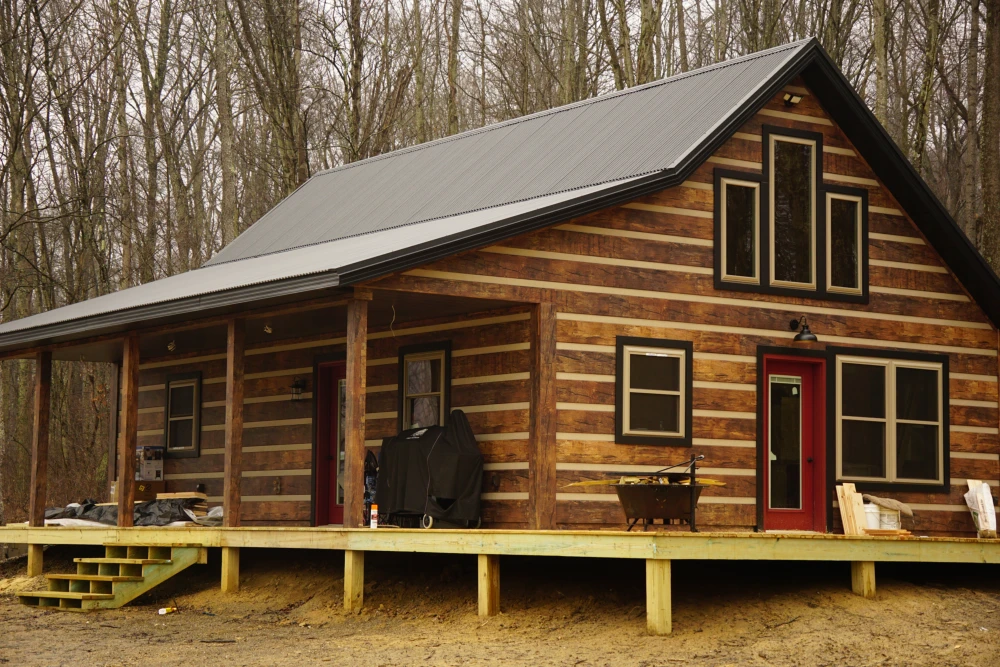
Maine's camp and second-home market is the largest in New England by property count, and it creates a specific requirement: the exterior has to perform through the full winter without anyone watching. A camp with failing vinyl or deteriorating wood siding discovered in May has already absorbed a full winter's damage. Steel siding runs through Maine's winter the same way it runs through summer, without needing to be checked.
Maine sits at the northern edge of the termite range, and subterranean colony activity is effectively absent statewide, removing one condition from the stack that every state to the south carries. The log and timber aesthetic applies to more Maine properties than any other New England state, covering lakefront camps, mountain retreats, sporting camps in the interior, and year-round homes across the rural north and west.
Maine's regions each carry the conditions at different intensities: Portland and the southern coast are the largest market, midcoast Maine from Brunswick through Rockland is the premium coastal market, Down East from Ellsworth to Eastport is the most remote and the saltiest, and Aroostook County runs the coldest temperatures in New England.
The Most Advanced Steel Siding On The Market
- 20 Year Fading & Chalking Warranty
- 50 Year Flaking & Peeling Warranty
- Lasts 40-60+ Years
- One Person Installation
Climate & Conditions Across Maine
Maine's climate separates clearly by distance from the coast and distance from the Canadian border. Salt air intensity, winter severity, and storm exposure all vary enough across the state's regions to produce four genuinely different condition stacks.
Portland and the southern coastal communities from Kittery and York through Old Orchard Beach and north to Brunswick are Maine's largest residential siding market. The southern coast has Maine's mildest winters, though that still means January lows in the low teens and a hard freeze-thaw season. Salt air is a year-round condition at any property within a mile of tidal water. Housing stock here mixes Victorian resort-era homes with year-round colonials and cape cods, and the re-siding market runs year-round rather than on the seasonal schedule that applies in the interior. Properties on exposed headlands and peninsulas face wind-driven salt rain through the full nor'easter season from November through March.
Midcoast Maine from Bath through Rockland and Camden to Blue Hill carries the state's highest concentration of high-value coastal properties. Penobscot Bay communities, island communities served by ferry from Rockland, and the peninsula communities of Knox, Lincoln, and Hancock counties sit in continuous salt air contact and face the full Atlantic storm load. The Camden and Rockland corridor is where the maintenance-free argument and the long warranty are most direct: properties on islands accessible only by ferry have a particular need for exterior materials that don't require tradespeople to travel by boat to address maintenance failures.
Down East Maine from Ellsworth through Washington County and Eastport carries the most remote conditions in the state. Salt air exposure is intense and nearly continuous in the coastal communities. Re-siding demand here is slower than in the southern markets, but the conditions are the most demanding: exterior materials that fail in the Down East environment wait longer for replacement, through more of Maine's winter, than anywhere else in the state. Working fishing communities of Jonesport, Beals Island, and Eastport have a practical relationship with exterior materials, and the durability case for steel resonates most directly in places where a siding failure in October might not get addressed until May.
Western Maine from Bethel and Sunday River through Kingfield, Carrabassett Valley, and Rangeley carries the state's strongest mountain resort market and its most active log and camp aesthetic. Ski resort communities, lake towns, and the sporting camp culture of the Rangeley Lakes region create consistent demand for the hand hewn log profile. Aroostook County in the far north runs the harshest winters in the state, with Caribou's January average below zero and freeze-thaw cycles that run from September through May in hard years. No meaningful salt air reaches Aroostook, but the cold argument is self-sufficient.
Need help finding an installer?
Why Steel Siding Is Right for Maine
Three conditions are active across Maine. Each one has a documented failure pattern in the materials most Maine homes currently carry, and each one has a specific answer in 26-gauge steel.
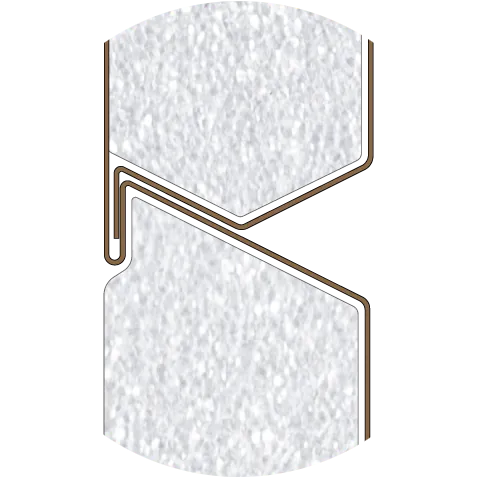
Freeze-thaw cycling applies hardest and longest in Maine of any East Coast state. Steel doesn't absorb moisture, so there's nothing inside the panel to freeze, expand, and crack when temperatures drop. The Slide-Lock panel system handles the dimensional changes that temperature swings produce in the steel without creating gaps at joints or pulling fasteners loose. Vinyl goes brittle below 20 degrees exactly when Maine winters put the most wind stress on exterior materials. Wood opens at joints through repeated moisture absorption and release over a six-month freeze-thaw season at elevation. Steel performs the same way in January and July because the mechanism that damages other materials in cold has nothing to act on.
Salt air along Maine's coast creates two failure modes in conventional materials: surface coating failure and fastener corrosion. Surface coating failure is visible over years as paint fades and separates from the material beneath. Fastener corrosion is invisible until the installation begins pulling apart at connections behind the panel face. The AZ55 Galvalume base coat bonds a zinc-aluminum alloy to the steel core at the manufacturing stage, providing corrosion resistance at the material level rather than at the paint surface. In a salt air environment as persistent as Maine's coastline, that distinction extends the protection timeline to the full life of the installation.
Maine's camp and second-home market has a specific requirement: the exterior material has to perform through the full winter without anyone watching. A camp on a lake in Aroostook County or a ski house in Carrabassett Valley sits vacant from October through April, absorbing every freeze-thaw cycle and every nor'easter without a maintenance visit. Steel siding's 50-year warranty against peeling, chipping, cracking, and flaking applies through the same conditions that cause those failures in other materials.
Atlantic storm and nor'easter exposure put wind resistance on the specification for every coastal Maine installation. SteeLuxe's Slide-Lock panel system creates a mechanical interlock between panels that holds under sustained wind loads. Wind load distributes through the panel-to-panel connection rather than concentrating at the nail hem attachment point, where conventional siding fails first. Class A fire rating and Class 4 impact resistance are standard across the full line.
Product Specifications
| Spec | Value |
|---|---|
| Gauge | 26-gauge steel (~25% thicker than 29-gauge) |
| Core | EPS foam, R-3.57 continuous insulation value |
| Fire Rating | Class A (highest available) |
| Impact Rating | Class 4 (highest available) |
| Colors | 50 solid colors (Sherwin Williams WeatherXL) |
| Wood Grain | 22 patterns (Kynar 500 resin) |
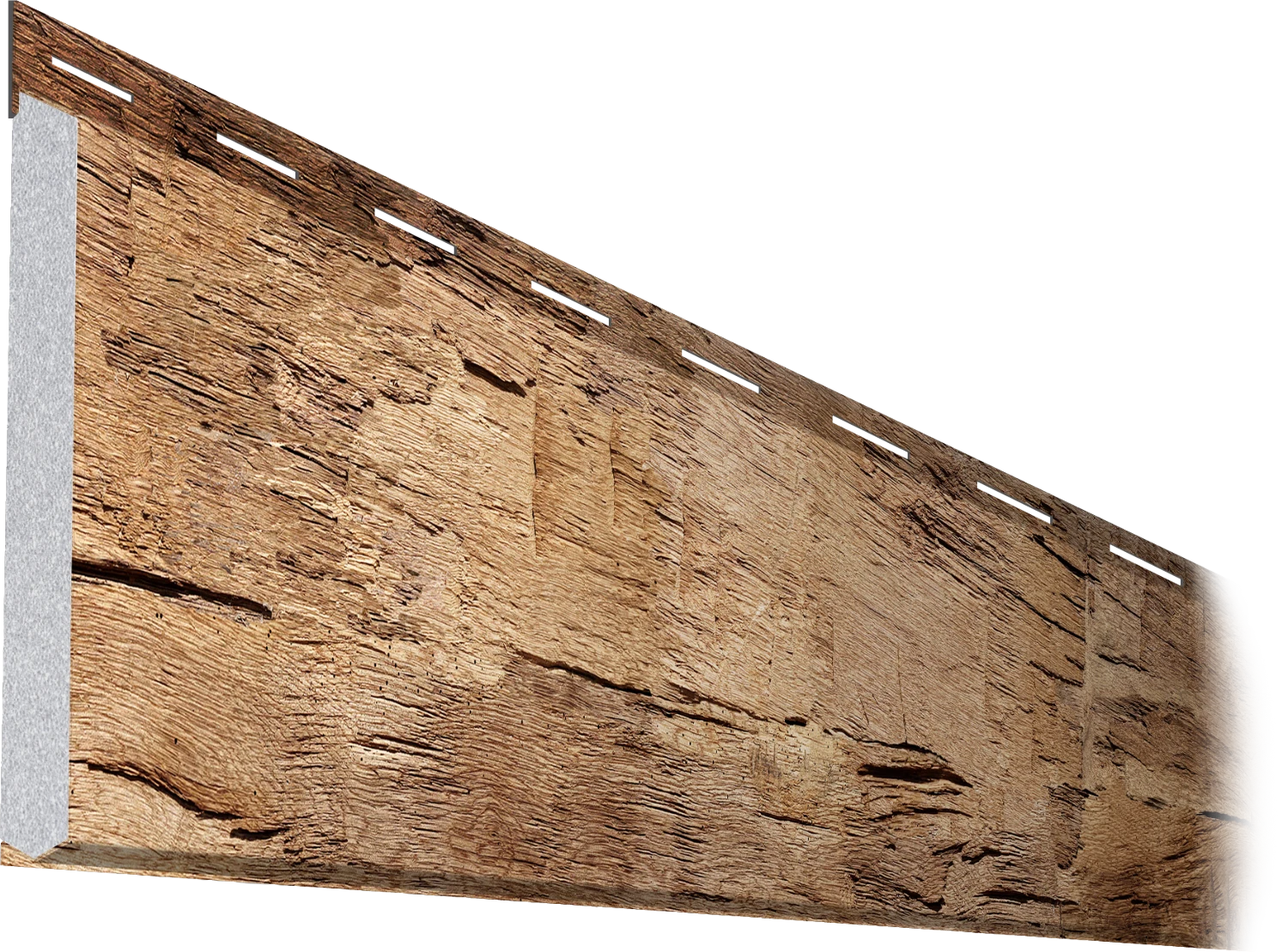
| Log Profile | Hand hewn log siding with chinking — 4 chinking colors |
| Warranty | 50-year peeling/flaking | 20-year fade/chalk |
| Panel | 10-inch planks, Slide-Lock system, one-person install |
| Base Coat | AZ55 Galvalume (zinc-aluminum alloy corrosion barrier) |
| Origin | New Philadelphia, Ohio — direct ship to all 49 states |
Hand Hewn Log Siding with Chinking
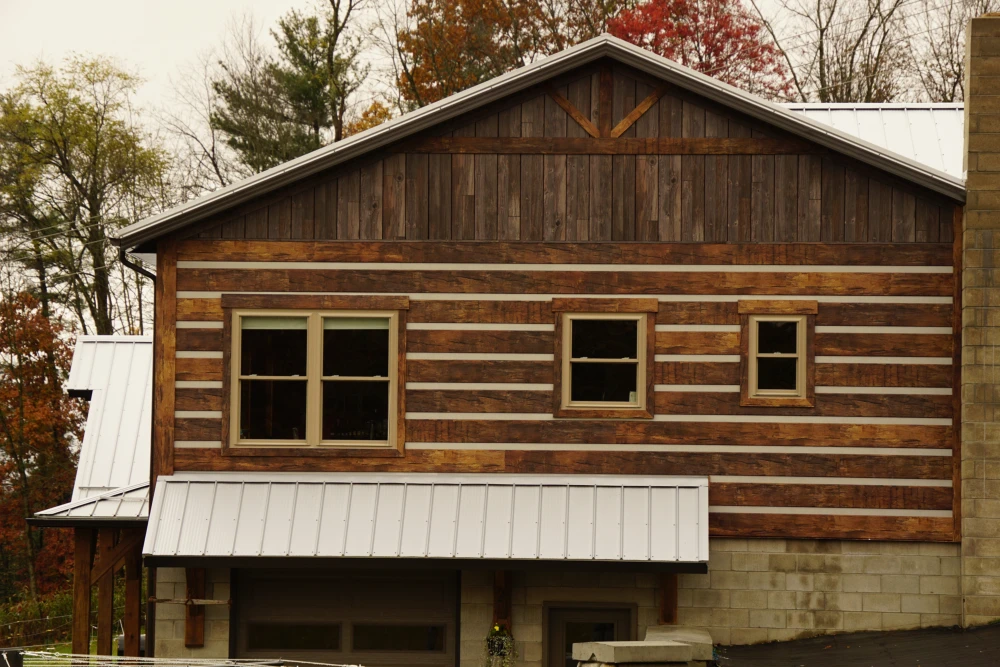
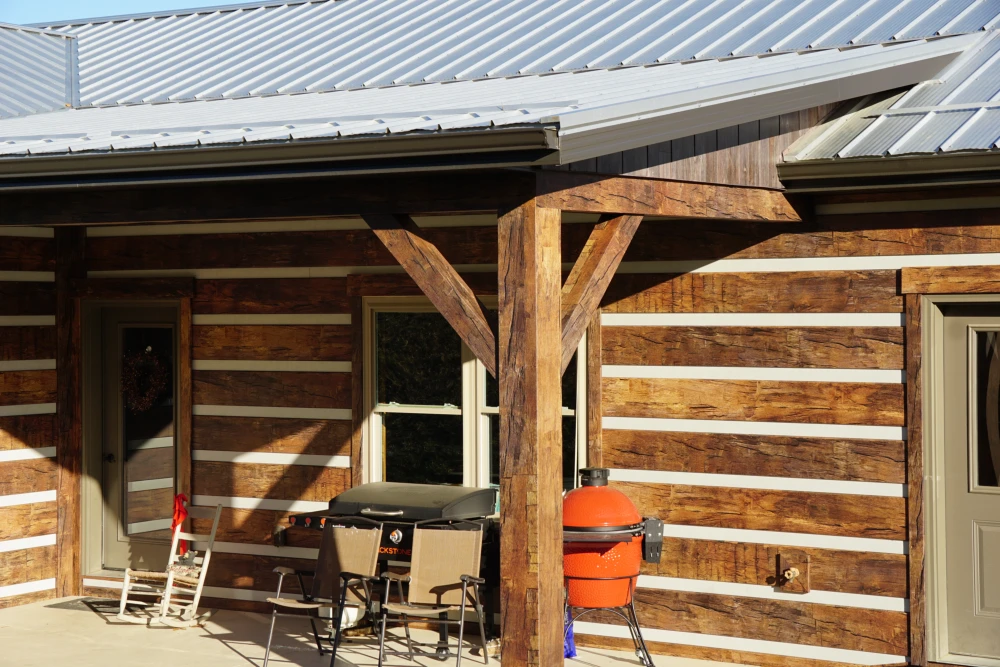
Maine carries the strongest log and camp siding market in New England. Lake camps, hunting camps, sporting camps, and mountain retreats from the Rangeley Lakes through Moosehead Lake and across Aroostook County represent a market where the hand hewn log profile is the expected aesthetic for the property type. New camps get built in it, re-siding projects follow it, and buyers of lake and sporting properties expect to see it.
Real wood log siding in Maine's interior and western mountains faces the state's most aggressive freeze-thaw cycling. Moisture works into wood grain and log joints through the long shoulder seasons, and the freeze phase runs hard enough in Aroostook County and the western mountains to crack log joints that have absorbed water during the fall. Repainting or re-staining a camp's log siding requires access during the short Maine summer, and the window for exterior painting in the north is shorter than anywhere else in New England.
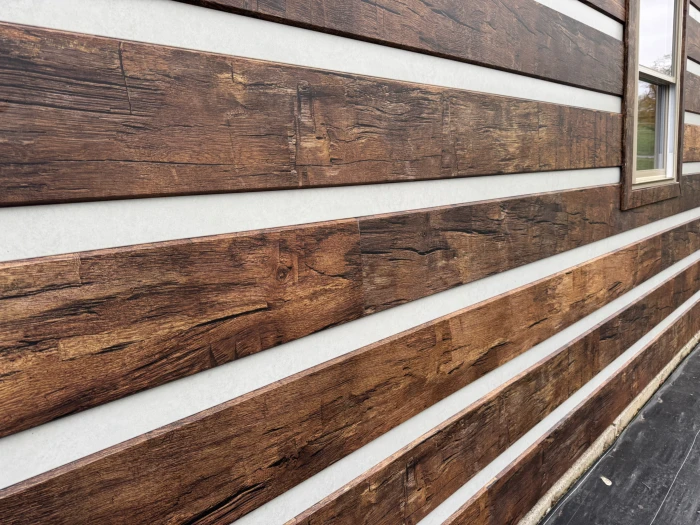
Hand hewn log siding with chinking in 26-gauge steel delivers the camp and mountain aesthetic without those failure modes. Steel doesn't absorb moisture, so the freeze-thaw cycle that splits wood grain at log joints has nothing to act on. The hand hewn surface replicates the texture and dimensional variation of actual milled log siding. Chinking fills the joints in four colors: Ash Gray, Charcoal, Clay, and Sandstone Tan. From the road, it reads as traditional log construction.
SteeLuxe is the only manufacturer making hand hewn log siding with chinking in steel. It ships direct from New Philadelphia, Ohio to lake camps, sporting retreats, and year-round homes throughout Maine, available across all 22 wood grain patterns in the SteeLuxe line.
Ready to Transform Your Home With Hand-Hewn Log Cabin Siding?
Get the authentic hand-hewn cabin look with the chinking detail you love, and never think about maintenance again. SteeLuxe steel siding is insulated, fire-rated, hail-resistant, and built to last a lifetime. See it and feel it for yourself.
Steel Siding vs the Alternatives
Maine's freeze-thaw and salt air combination produces specific failure patterns in each major siding material, and the timeline those failures run on in Maine is shorter than in more temperate climates.
Vinyl is the most common siding replacement material on Maine homes over the last 30 years, and it carries two problems in this climate. Below 20 degrees, vinyl loses the flexibility it needs to absorb the stress of wind load and panel expansion and contraction. Maine's winters push vinyl through that brittle range from December through February statewide, and through October and March at elevation. When vinyl becomes brittle, wind events that wouldn't damage a warmer-season installation cause panel cracking and fastener pull-through. Salt air doesn't degrade vinyl's surface visibly, but it corrodes the aluminum and steel trim systems, J-channels, and fasteners behind the panel face on a timeline that becomes structural before it becomes visible. Replacing vinyl with vinyl in a coastal Maine location restarts the same failure clock.
Fiber cement holds up to cold better than vinyl and carries a Class A fire rating, but it has two Maine-specific problems. Cut edge moisture absorption is the first. Maine's freeze-thaw season is long enough and cold enough that moisture working into cut fiber cement edges at penetrations and trims goes through dozens of freeze cycles per season, expanding and contracting in ways that cause edge cracking and surface separation faster than in milder climates. Factory paint on fiber cement requires repainting on a 10 to 15-year cycle under normal conditions, and in a coastal Maine environment that cycle shortens. Class 4 impact resistance is not available in fiber cement.
Wood siding is the historically appropriate material for most of Maine's coastal colonial and cape cod architecture, and it performs better than the alternatives in mild conditions. Maine's conditions are not mild. Paint on wood siding in a salt air environment fails every 5 to 8 years, and the prep and repaint cycle at a coastal Maine property often requires scaffolding or lift equipment on the ocean-facing elevation. In the camp market, the repaint cycle competes with the short Maine summer for the same window. Over a 30-year ownership period, the cost and time of maintaining wood siding on a Maine coastal or camp property is the argument that sends most owners toward a better material at the next replacement.
Frequently Asked Questions
Q:What makes SteeLuxe steel siding different from other steel siding products?
Q:How does the Slide-Lock installation system work?
Q:What wood grain patterns are available?
Q:Does steel siding rust?
Q:How does Maine's cold affect steel siding compared to vinyl?
Q:Is steel siding a good choice for a Maine camp or seasonal property?
Q:How does salt air from the Maine coast affect steel siding?
Q:Does SteeLuxe install in my city?
Q:Does the log siding profile look authentic on a Maine camp?
Maine Cities & Regions We Serve
SteeLuxe ships from New Philadelphia, Ohio to residential, camp, and contractor projects across all 16 Maine counties, with lead times that work for both year-round re-siding and the seasonal construction windows that the camp and resort markets depend on.
Portland and the Greater Portland area, including South Portland, Westbrook, Scarborough, Cape Elizabeth, and the York County communities from Kittery through Saco, make up the state's largest residential siding market. Year-round construction activity here runs on a consistent schedule, and the housing stock ranges from Victorian resort-era homes to post-war capes and colonials to newer construction on the expanding suburban ring south and west of the city.
The midcoast from Brunswick through Rockland, Camden, and Belfast to Ellsworth carries the state's highest concentration of premium coastal properties. Island communities in Penobscot Bay, the peninsula communities of Knox and Lincoln counties, and the Bar Harbor and Acadia corridor represent the market where the salt air and low-maintenance arguments are most direct. Many of these properties are second homes, which increases the requirement for an exterior material that holds condition without regular attention.
Western Maine, including the Bethel and Sunday River corridor, Kingfield and Sugarloaf, and the Rangeley Lakes region, is the state's strongest market for log and camp siding profiles. Aroostook County in the far north, including the Caribou and Presque Isle communities and the agricultural communities of the St. John Valley, carries the state's most demanding cold-weather conditions.
Full city pages with local installer contacts and current pricing are available for Portland, ME. More Maine cities are listed below:
Don't see your city listed here. Contact SteeLuxe directly and someone familiar with Maine's regional conditions will point you to the nearest installer and current pricing for your area.
Get a Quote for Steel Siding in Maine
SteeLuxe is manufactured in New Philadelphia, Ohio and ships direct. Whether you are planning a full re-siding project or exploring options, we can get you pricing, color samples, and a list of installers in your area.