
Steel Siding & Hand Hewn Log Siding in Florida
Steel Siding in Florida
Steel siding in Florida faces five conditions simultaneously, and unlike most states where one or two conditions dominate, Florida applies all of them at full intensity year-round. Florida carries the highest termite pressure classification in the country, Very Heavy, covering every county in the state. Both subterranean and drywood termite species are active across every Florida county with no seasonal suppression. The entire peninsula sits inside FEMA's hurricane-prone region. Florida has absorbed more direct hurricane landfalls than any other state, with catastrophic damage documented from Andrew in 1992, Charley in 2004, Irma in 2017, Ian in 2022, and Helene and Milton in 2024. Over 1,350 miles of Atlantic and Gulf coastline bring salt air to both sides of the peninsula simultaneously. Summer temperatures reach 91 degrees and hold there. Humidity is tropical across the entire southern half of the state.
No other state applies this many conditions at this intensity. The argument for steel siding in Florida isn't that it performs better in one category. It's that it handles every Florida condition in the same panel without requiring organic content that termites eat, painted surfaces that heat and humidity attack, or materials that hurricane-force wind and water penetrate. Florida is the most complete case for steel in the continental United States.
The wood siding problem in Florida is severe. Very Heavy termite pressure means colonies are working in the soil around every Florida home continuously, and wood gives them direct access to food at the wall level. Salt air accelerates paint failure on wood to a 3 to 5-year cycle on coastal properties. Extreme heat and humidity cause wood to expand and contract on a year-round schedule that opens gaps at joints and accelerates surface degradation. Repainting and resealing wood siding in a Florida coastal environment is expensive, frequent, and futile in the long run.
Vinyl fails in Florida primarily because of heat. Florida summers push vinyl through repeated expansion and contraction cycles that loosen panels from fasteners over time and cause surface fading that no paint touch-up can address. Vinyl also provides no protection for the structural materials underneath against termite pressure and has no wind rating that qualifies for Florida's hurricane coastal requirements. After Ian and Milton, Florida contractors and homeowners have both sharpened their understanding of what exterior materials actually hold in a hurricane.
Wood grain siding in the 22 patterns SteeLuxe manufactures covers the full range of Florida residential aesthetics: the beach cottage and Key West vernacular of the coastal communities, the Spanish and Mediterranean-influenced profiles of South Florida, the craftsman and bungalow character of older neighborhoods in Jacksonville and Tallahassee, and the Southern cottage look of the Panhandle. Steel delivers all of those profiles without the termite vulnerability and maintenance cycle that makes wood impractical in Florida's climate.
Four distinct Florida markets each carry the full set of conditions at different intensities. South Florida, the Gulf Coast, Central Florida, and the North Florida Panhandle each get their own breakdown in the sections below.
The Most Advanced Steel Siding On The Market
- 20 Year Fading & Chalking Warranty
- 50 Year Flaking & Peeling Warranty
- Lasts 40-60+ Years
- One Person Installation
Climate & Conditions Across Florida
All five Florida conditions are present across the entire state. What shifts by region is which ones run at maximum intensity and which ones dominate the product conversation at the local level.
South Florida: Miami Through the Keys
South Florida has no meaningful winter. Temperatures stay warm year-round, humidity is tropical, and the termite pressure in Miami-Dade, Broward, and Palm Beach counties is among the most intense in the continental United States. Both subterranean colonies in the soil and drywood termites in the wood itself are active simultaneously. The Atlantic Ocean sits to the east and Florida Bay to the south and west, making salt air a continuous presence from both directions. Miami and the surrounding coastal communities are also directly in the Atlantic hurricane track that has produced multiple catastrophic landfalls. The combination of heat, humidity, salt air, and termites with no seasonal relief makes South Florida the most demanding single residential environment for exterior siding in the country.
The Gulf Coast: Naples Through Tampa to the Panhandle
The Gulf Coast has absorbed the most frequent direct hurricane landfalls of any Florida region. Hurricanes Charley, Irma, Ian, and Milton all made landfall on or near the Southwest Florida coast, causing catastrophic structural damage across Lee, Charlotte, Sarasota, and Collier counties. The Gulf of Mexico creates a warm salt air environment that's present year-round along the coast from Naples through Fort Myers, Sarasota, Tampa, and north through the Panhandle shoreline. Termite pressure is Very Heavy throughout. The post-Ian and post-Milton rebuild market in Southwest Florida represents significant demand for exterior products that qualify for Florida's building code wind load requirements.
Central Florida: Orlando and the Interior
Central Florida doesn't have the direct coastal exposure that the coasts carry, but all five conditions are still present. Termites are Very Heavy statewide. Heat and humidity run at full Florida intensity through the long season. Orlando is far enough inland to skip the direct salt air influence, but wind and rain from major storm systems still reach the interior, and Ian tracked directly over the Orlando metro in 2022. Central Florida is the state's largest single residential market and carries significant re-siding demand from aging vinyl and damaged exterior materials.
North Florida and the Panhandle
The Panhandle and North Florida run cooler than the peninsula, with occasional winter cold snaps, but they still carry Very Heavy termite pressure, active hurricane exposure, and high humidity through the long warm season. Gulf Coast communities from Pensacola through Panama City and Destin carry the full salt air and hurricane argument along with the state's universal termite pressure, making the Panhandle beach cottage and second-home market a strong fit for the zero-maintenance steel case.
Need help finding an installer?
Why Steel Siding Is Right for Florida
Every Florida condition has a specific answer in 26-gauge steel, and no other single material answers all five in the same panel.
Very Heavy termite pressure statewide is the starting point. Both subterranean and drywood species are active year-round across every Florida county. Steel gives termites nothing to eat because there's no wood in the panel, no food source, and no moisture pathway a colony can exploit at the wall level. That protection doesn't require chemical treatment, monitoring, or retreatment. It holds for the full life of the installation because the material termites need simply isn't present.
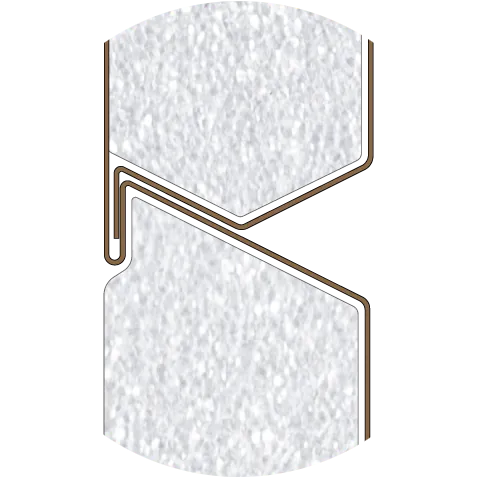
Hurricane exposure across the entire Florida peninsula makes wind resistance and structural integrity the non-negotiable specification for every exterior installation. SteeLuxe's Slide-Lock panel system creates a mechanical interlock between panels that holds under sustained wind loads. Class A fire rating is standard. For Florida's building code requirements and insurance carrier specifications, steel at Class 4 impact resistance and with a mechanically interlocked panel system is the product category that actually meets what the state's wind exposure demands.
Salt air from both coasts attacks exterior materials from two directions across most of the Florida peninsula. The AZ55 Galvalume base coat bonds a zinc-aluminum alloy to the steel core at the manufacturing stage, providing corrosion resistance from inside the material rather than from a surface coating that fails when scratched or worn. Painted wood and vinyl trim corrode at fasteners and joints in a Florida salt air environment on a timeline measured in years, not decades. Galvalume-core steel resists across the full 40 to 60-year panel life.
Extreme heat and year-round humidity are the final argument. Steel doesn't absorb moisture, so the expansion and contraction cycle that loosens vinyl from fasteners and causes wood to check and gap is a non-issue. The 26-gauge thickness holds its shape and size through Florida's year-round heat cycle, and the Kynar 500 and Sherwin Williams WeatherXL finishes hold color without chalking or fading under extended UV exposure at Florida's latitude and intensity.
Product Specifications
| Spec | Value |
|---|---|
| Gauge | 26-gauge steel (~25% thicker than 29-gauge) |
| Core | EPS foam, R-3.57 continuous insulation value |
| Fire Rating | Class A (highest available) |
| Impact Rating | Class 4 (highest available) |
| Colors | 50 solid colors (Sherwin Williams WeatherXL) |
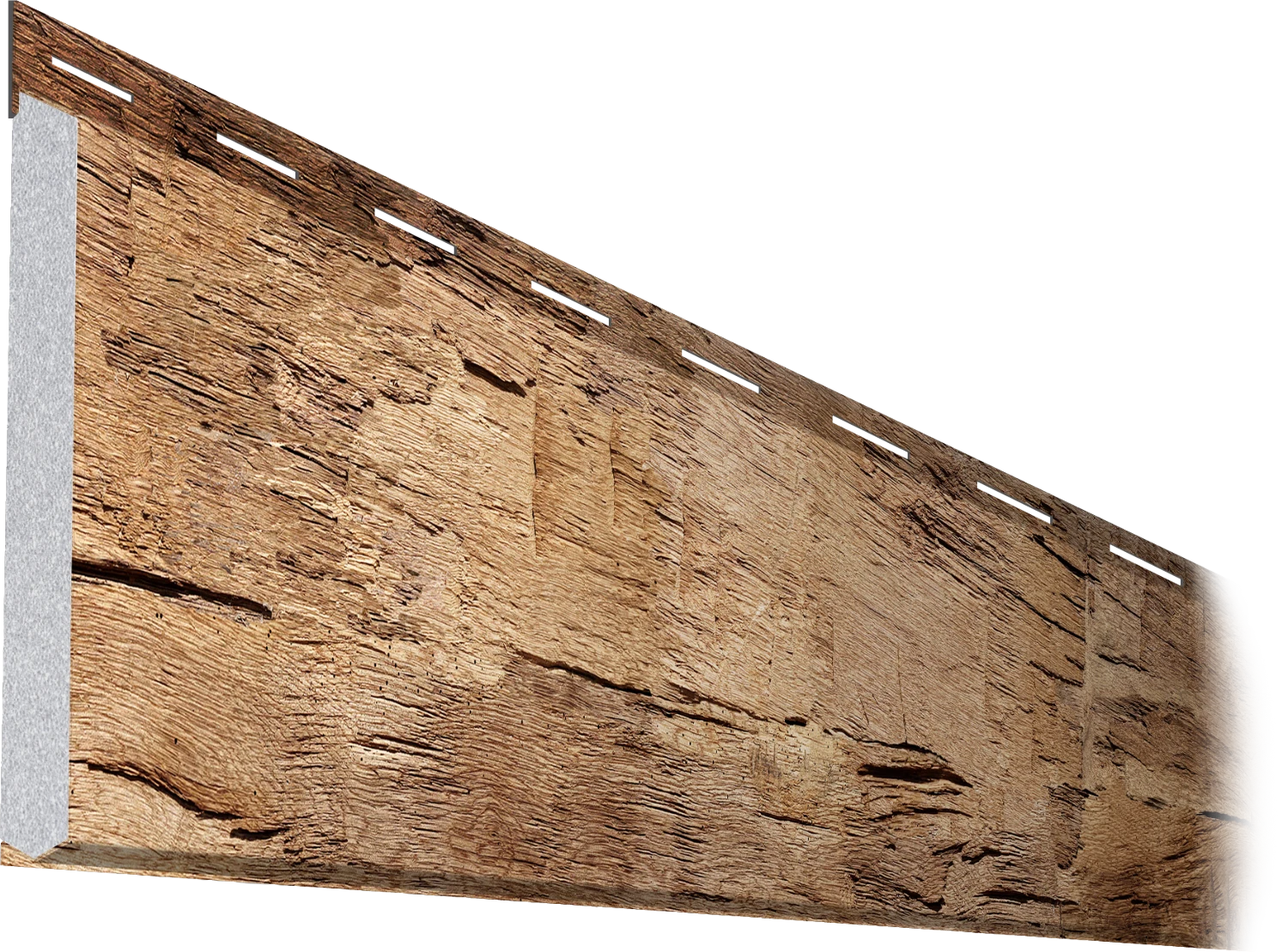
| Wood Grain | 22 patterns (Kynar 500 resin) |
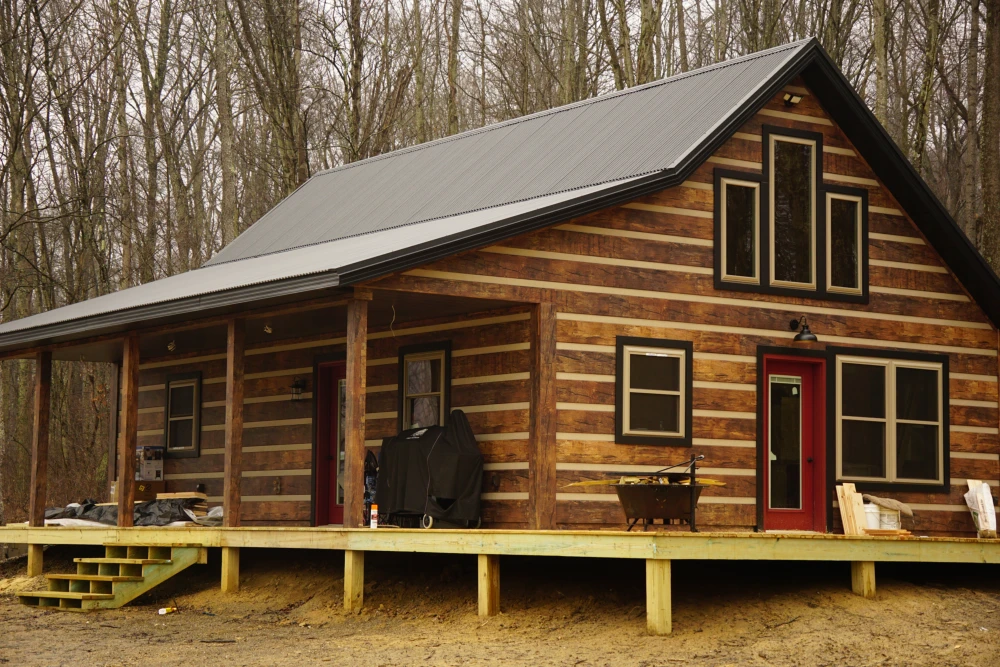
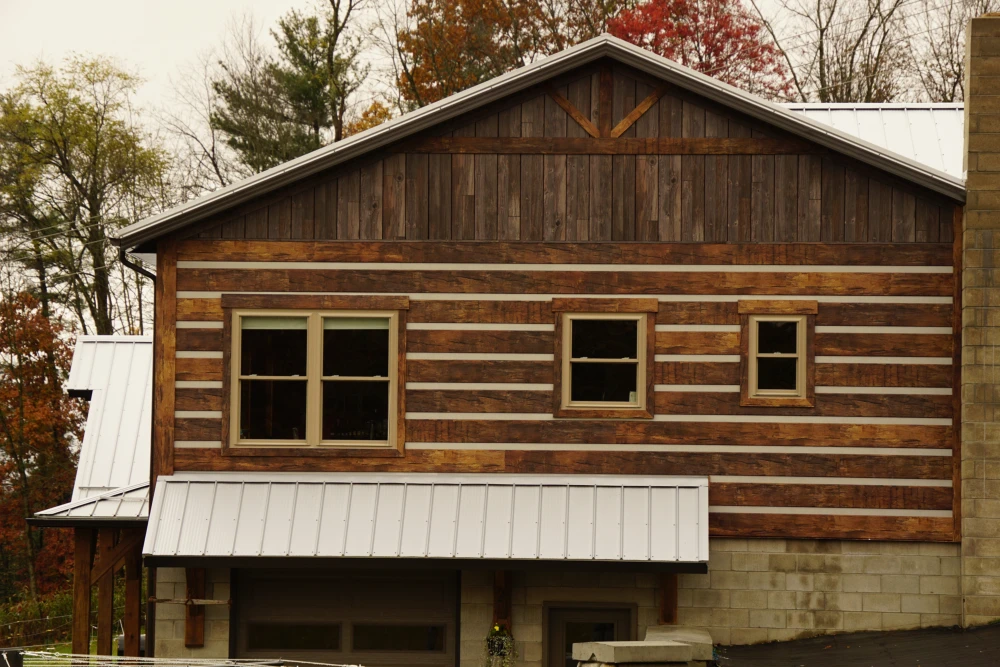
| Log Profile | Hand hewn log siding with chinking — 4 chinking colors |
| Warranty | 50-year peeling/flaking | 20-year fade/chalk |
| Panel | 10-inch planks, Slide-Lock system, one-person install |
| Base Coat | AZ55 Galvalume (zinc-aluminum alloy corrosion barrier) |
| Origin | New Philadelphia, Ohio — direct ship to all 49 states |
Hand Hewn Log Siding with Chinking in Florida
Florida isn't a primary log siding market the way the Mountain West and Appalachian regions are, but the Panhandle and North Florida carry a Southern cottage and rural vernacular where the rustic timber profile fits the landscape. Rural properties in the interior counties, hunting camps, and country retreats in areas like the Big Bend coast and the Florida Highlands have a residential character where log profiles make sense architecturally.
Real wood log siding in Florida faces the most hostile environment in the country. Very Heavy termite pressure means active colonies in the soil are working at every installation continuously. The extreme humidity keeps wood at elevated moisture content year-round, which accelerates surface degradation and makes staining and sealing a constant maintenance requirement. In a high-heat, high-humidity, high-termite environment, real wood log siding fails faster than in any other region of the country.
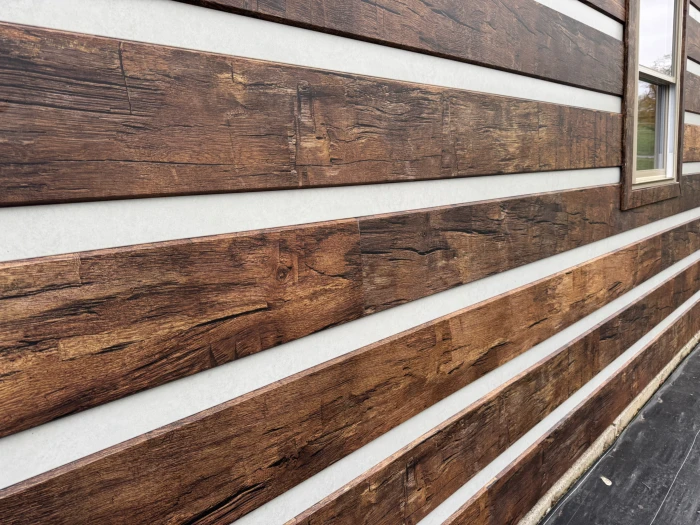
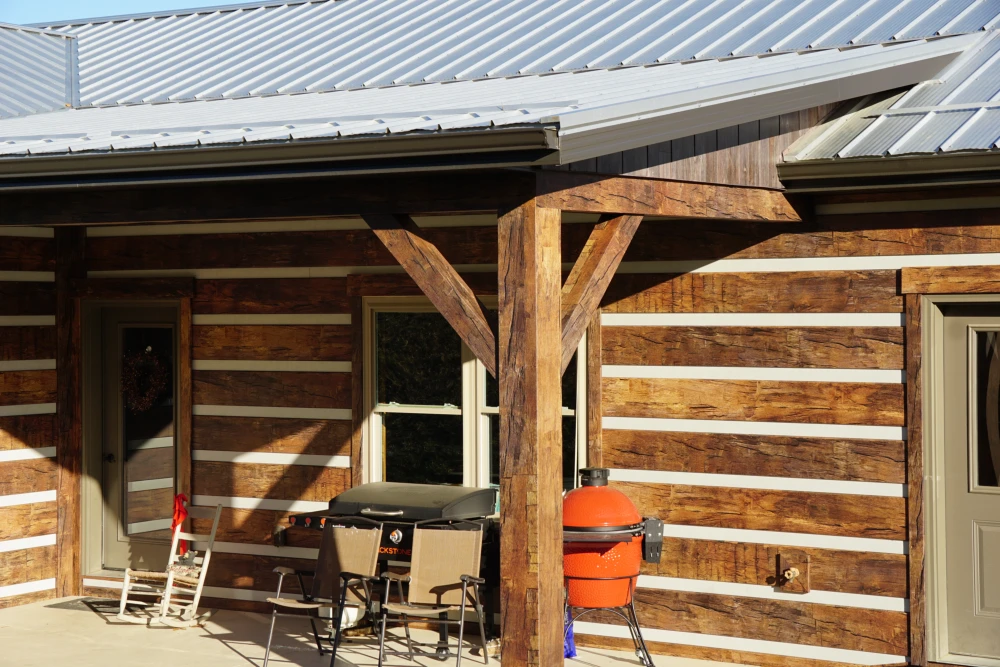
Hand hewn log siding with chinking in 26-gauge steel delivers the authentic timber profile without those failure modes. Steel gives termites nothing to eat. The finish holds through Florida's heat and humidity without the staining and sealing cycle real wood demands. SteeLuxe is the only manufacturer making this product in steel, and it carries a Class A fire rating that no wood log siding product can offer.
Hand hewn log siding with chinking ships direct from New Philadelphia, Ohio to Florida projects. It's available in four chinking colors: Ash Gray, Charcoal, Clay, and Sandstone Tan, across all 22 wood grain patterns in the SteeLuxe line.
Ready to Transform Your Home With Hand-Hewn Log Cabin Siding?
Get the authentic hand-hewn cabin look with the chinking detail you love, and never think about maintenance again. SteeLuxe steel siding is insulated, fire-rated, hail-resistant, and built to last a lifetime. See it and feel it for yourself.
Steel Siding vs the Alternatives in Florida
Vinyl is the most widely installed replacement siding in Florida, and it has three specific problems in this climate. Heat causes vinyl to expand and contract on a year-round cycle that loosens panels from fasteners over time, opens gaps at seams, and causes surface fading that can't be touched up. Vinyl has no fire rating and no impact resistance classification that meets Florida's coastal wind load requirements. After Ian and Milton, Florida homeowners on the Gulf Coast saw exactly how vinyl performs in hurricane-force wind and storm surge: it fails. It also provides zero protection against the termite pressure working in the soil at every address.
Fiber cement performs better than vinyl in impact and wind resistance, but it carries two liabilities that Florida's climate exposes quickly. Moisture absorption at cut edges and penetrations is the first. In a high-humidity, tropical-rainfall environment, fiber cement absorbs moisture through every cut edge and installation penetration, and the repeated cycle of wetting and drying causes cracking and surface separation faster than in drier climates. The second problem is termite vulnerability in the framing and wood trim behind the installation. Fiber cement panels don't give termites anything directly, but the wood structural members and trim at the wall level do, and the panel itself doesn't eliminate the food source the way steel does.
Wood siding is the most direct statement of Florida's five conditions and why steel answers all of them. Termites at Very Heavy pressure treat wood siding as food. Salt air from two coasts causes paint to fail on a 3 to 5-year cycle on coastal properties. Extreme heat and humidity expand and contract wood continuously, opening joints and accelerating surface checking. Hurricane-force winds strip wood siding off framing when fasteners fail under sustained load. Wood needs constant maintenance in Florida and still loses over time. There is no version of wood siding that holds up well in a South Florida or Gulf Coast environment.
Steel siding at 26-gauge carries the Class 4 impact rating vinyl can't reach, the moisture resistance fiber cement can't maintain at cut edges, and the absence of any organic material that eliminates wood siding's terminal termite problem. For Florida coastal properties, the AZ55 Galvalume core provides corrosion protection that no painted surface delivers at the base material level.
Frequently Asked Questions
Q:What warranty does SteeLuxe steel siding carry?
Q:Can one person install SteeLuxe steel siding?
Q:What colors does SteeLuxe steel siding come in?
Q:Where is SteeLuxe manufactured and how does shipping work?
Q:How does steel siding handle Florida's termite pressure?
Q:Does steel siding meet Florida's hurricane wind load requirements?
Q:How does salt air from both coasts affect steel siding in Florida?
Q:What Florida cities does SteeLuxe serve?
Q:Is steel siding a good choice for homes rebuilding after Hurricane Ian or Milton?
Florida Cities & Regions We Serve
SteeLuxe ships from New Philadelphia, Ohio to residential and contractor projects across Florida. Every Florida installation qualifies for the full AZ55 Galvalume specification and the complete five-condition performance argument.
South Florida, including the Miami metro, Fort Lauderdale, and Palm Beach, is the state's highest-intensity market for termite pressure, heat, and salt air. The post-Ian rebuild market on the Gulf Coast, particularly in the Jacksonville, FL and Jacksonville, FL areas of Lee and Charlotte counties, is a major active re-siding market driven by homeowners making post-hurricane material upgrades. Tampa Bay, Sarasota, and the Southwest Florida corridor carry the full hurricane, salt air, and termite stack.
Central Florida and the Jacksonville, FL metro represent the state's largest single population center. The market here is driven by aging vinyl on homes built from 1980 through 2010 and growing awareness of the termite and hurricane performance gap between vinyl and steel. North Florida and the Panhandle carry the full Florida condition set at lower heat intensity, with the Panhandle beach communities adding the Gulf salt air and shore-home aesthetic argument.
Full city pages with local installer contacts and current pricing are available for Jacksonville, FL. More Florida cities are listed below:
Don't see your city listed here. Contact SteeLuxe directly and someone familiar with Florida's regional conditions will help you find the nearest installer and current pricing for your area.
Get a Quote for Steel Siding in Florida
SteeLuxe is manufactured in New Philadelphia, Ohio and ships direct. Whether you are planning a full re-siding project or exploring options, we can get you pricing, color samples, and a list of installers in your area.