Steel Siding & Hand Hewn Log Siding in Alabama
Steel Siding in Alabama
Alabama is one of the hardest states in the country on exterior siding, and steel siding in Alabama has to handle more at once than most materials are built for. Termites are the starting condition, and Alabama carries the federal government's highest termite classification statewide, meaning very heavy subterranean termite pressure across all 67 counties without exception. This isn't a regional problem concentrated in one corner of the state. Every county, from the Tennessee border to the Gulf Coast, sits in the same highest-pressure zone.
Heat compounds the problem. Summer highs average 91 degrees and the Gulf air makes the humidity feel worse than the temperature alone. Wood grain siding in the SteeLuxe line handles Alabama summers without the warping and paint failure that come with wood in a climate this hot and wet.
North Alabama brings hail into the picture. Birmingham and the Tennessee Valley sit in one of the Southeast's most active severe weather corridors, with peak season running March through May when storm systems that produce large hail and tornadoes track regularly through the region. South Alabama carries hurricane exposure on top of that. Mobile Bay and the Gulf Coast shoreline have taken direct hits from major storms, including Hurricane Katrina in 2005 and Hurricane Sally in 2020, and the coastal market lives with that reality in every siding decision.
Salt air is the fifth condition. It moves inland farther than most people expect. Mobile Bay, the Intracoastal Waterway, and the river systems feeding into the Gulf carry corrosive salt air well into Mobile County, reaching neighborhoods that don't think of themselves as coastal.
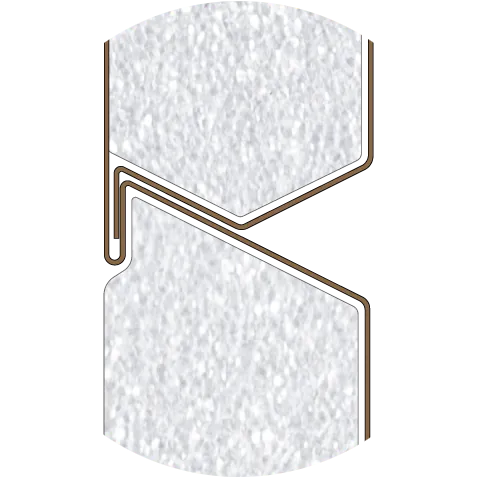
Steel handles all of this in the same panel. There's nothing in it for termites to eat or tunnel through. The AZ55 Galvalume base coat is a zinc-aluminum alloy bonded to the steel itself, which means the corrosion protection is in the metal, not on top of it in a coat that wears away. That matters in a salt air environment. Class 4 impact resistance is the highest hail rating available, and it's what Alabama's insurance carriers look for when pricing storm risk. A Class A fire rating means the panel won't catch fire or spread flame. EPS foam in the core adds R-3.57 of insulation, which cuts the load on cooling systems running hard through an Alabama summer.
Alabama's conditions don't look the same in every part of the state. Not even close. The Gulf Coast, Birmingham, the Black Belt, and the Tennessee Valley each put different demands on what's on the outside of a house. This page covers all four regions and what each one means for the siding decision.
The Most Advanced Steel Siding On The Market
- 20 Year Fading & Chalking Warranty
- 50 Year Flaking & Peeling Warranty
- Lasts 40-60+ Years
- One Person Installation
Climate & Conditions Across Alabama
Alabama covers a lot of climate ground. The distance from the Tennessee border to the Gulf of Mexico is only about 300 miles, but the siding conditions at those two ends of the state are genuinely different in ways that change what the right material is.
North Alabama: Birmingham, Huntsville, and the Tennessee Valley
North Alabama is the state's most active hail zone. The Tennessee Valley and the Birmingham metro sit in a storm corridor that produces severe weather with damaging hail and tornadoes from March through May every year. Hail events in this region regularly include stones large enough to crack vinyl panels and chip fiber cement. Termite pressure is very heavy throughout north Alabama, the same federal very-heavy classification that covers the rest of the state. Summer humidity is intense. Birmingham records an average of 50 or more significant hail events annually.
Central Alabama: The Black Belt and Montgomery
Central Alabama runs hot and humid for most of the year. The Black Belt region runs across the middle of the state and records some of the highest sustained temperatures in Alabama, with summer highs pushing past 90 degrees for months at a stretch. Humidity in this region doesn't break cleanly at the end of summer the way it does further north. Wood siding in the Black Belt absorbs moisture and gives termite colonies everything they need to get established, which is exactly what steel siding doesn't do.
South Alabama: Mobile, the Gulf Coast, and Baldwin County
The Gulf Coast carries Alabama's most demanding set of conditions. Mobile Bay and the shoreline communities of Gulf Shores and Orange Beach sit in FEMA's hurricane-prone region and have taken direct hits from major storms. Hurricane Sally in 2020 caused extensive siding damage across coastal communities from storm surge, wind, and wind-driven debris. Salt air from Mobile Bay moves well inland through the Intracoastal Waterway, corroding materials that weren't built to handle it. Termite pressure in Mobile County is the highest in the state. All of it hits at once down here.
Six conditions. Heat, hail, hurricane, salt air, termites, and humidity. In most of Alabama, four or five of those are active wherever you are in the state, and steel addresses all six without forcing a trade-off between them.
Need help finding an installer?
Why Steel Siding Is Right for Alabama
Six conditions are active in Alabama: heat, hail, hurricane, salt air, termites, and humidity. Here is what each one does in practice and why 26-gauge steel is the only material that handles all six in the same panel without a compromise between them. No other single material does.
Termites lead the list in Alabama. The federal government's very heavy classification covers all 67 Alabama counties without exception, and subterranean termite colonies are active in the soil across the entire state year-round. Steel siding gives them nothing to work with because there's no wood in the panel, no food, and no moisture a colony can use near the foundation. That protection doesn't degrade over time the way a chemical treatment does. It holds for the full life of the installation because steel simply isn't the material termites are built to attack.
Heat and humidity run year-round. Summer highs average 91 degrees, and the Gulf air keeps the humidity elevated even when temperatures drop in fall. Vinyl siding expands substantially in that kind of sustained heat and can pull loose from fasteners or gap at the seams over repeated summer cycles. Fiber cement absorbs moisture through Alabama's long humid season and needs repainting every 7 to 10 years because of it. Steel doesn't absorb moisture, and the Slide-Lock panel system handles normal expansion without pulling panels loose.
Hail is the dominant condition in north Alabama. Class 4 is the highest impact rating the IBHS system awards. A panel at that rating takes a two-inch steel ball dropped from 20 feet without cracking or chipping. Alabama insurance carriers recognize the rating, and many offer premium discounts for Class 4-rated exterior products in Birmingham and the Tennessee Valley, where hail frequency has pushed loss data high enough that carriers price the difference.
The Gulf Coast adds hurricane and salt air. Class A fire rating means the panel won't ignite or spread flame. The AZ55 Galvalume base coat fights corrosion from inside the steel itself, not from a surface layer that eventually scratches away. In a salt air environment like Mobile Bay, where corrosive air moves inland farther than most homeowners expect, that distinction is the difference between a 40-year installation and one that starts failing in 10.
Product Specifications
| Spec | Value |
|---|---|
| Gauge | 26-gauge steel (~25% thicker than 29-gauge) |
| Core | EPS foam, R-3.57 continuous insulation value |
| Fire Rating | Class A (highest available) |
| Impact Rating | Class 4 (highest available) |
| Colors | 50 solid colors (Sherwin Williams WeatherXL) |
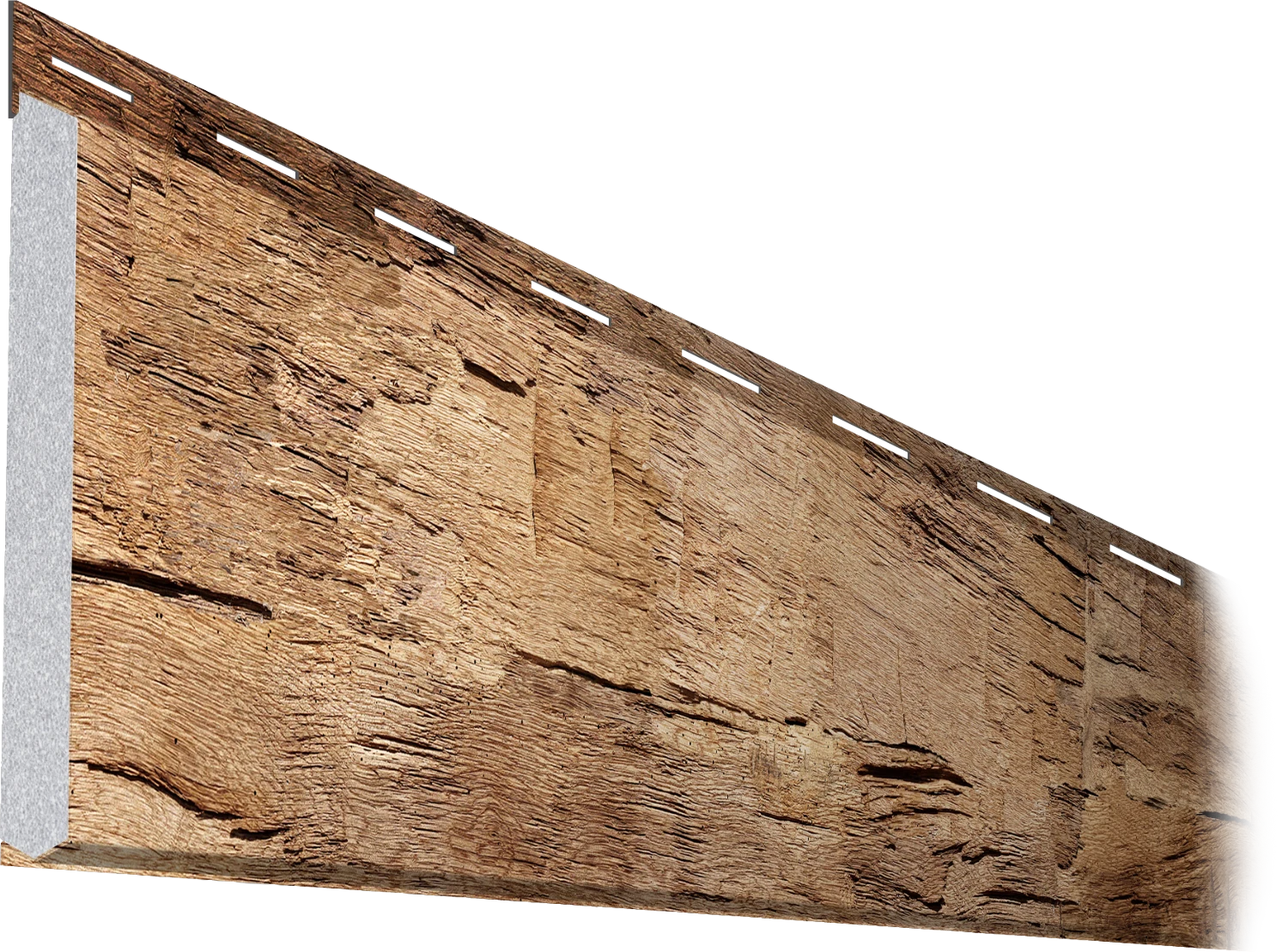
| Wood Grain | 22 patterns (Kynar 500 resin) |
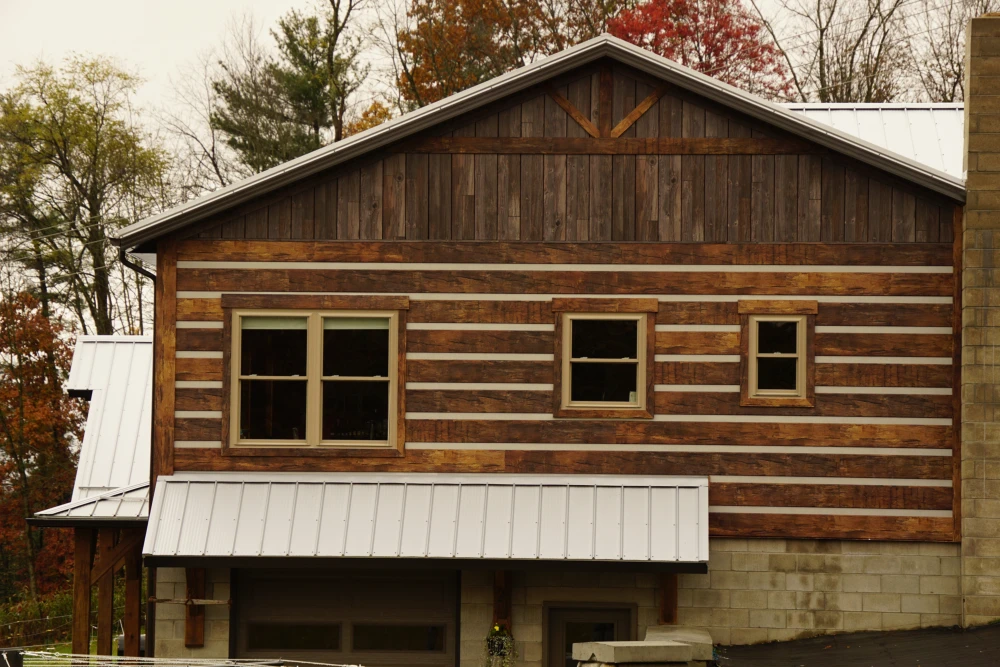
| Log Profile | Hand hewn log siding with chinking — 4 chinking colors |
| Warranty | 50-year peeling/flaking | 20-year fade/chalk |
| Panel | 10-inch planks, Slide-Lock system, one-person install |
| Base Coat | AZ55 Galvalume (zinc-aluminum alloy corrosion barrier) |
| Origin | New Philadelphia, Ohio — direct ship to all 49 states |
Hand Hewn Log Siding with Chinking in Alabama
Alabama's residential architecture runs the full range. The Gulf Coast has its beach cottage and raised-center-hall styles, built around shade, airflow, and raised foundations that keep living spaces above flood levels. Birmingham's historic neighborhoods are built on craftsman bungalow profiles. The rural counties of central and south Alabama carry a deep tradition of Southern farmhouse and shotgun construction. Log and timber profiles fit naturally into the farmhouse and rural vernacular across much of the state.
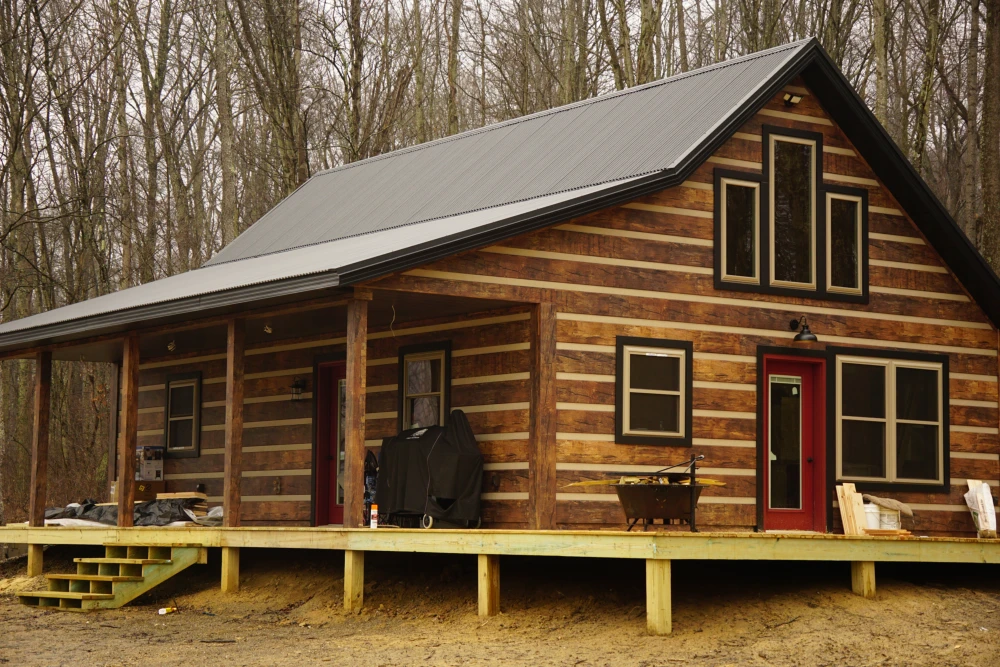
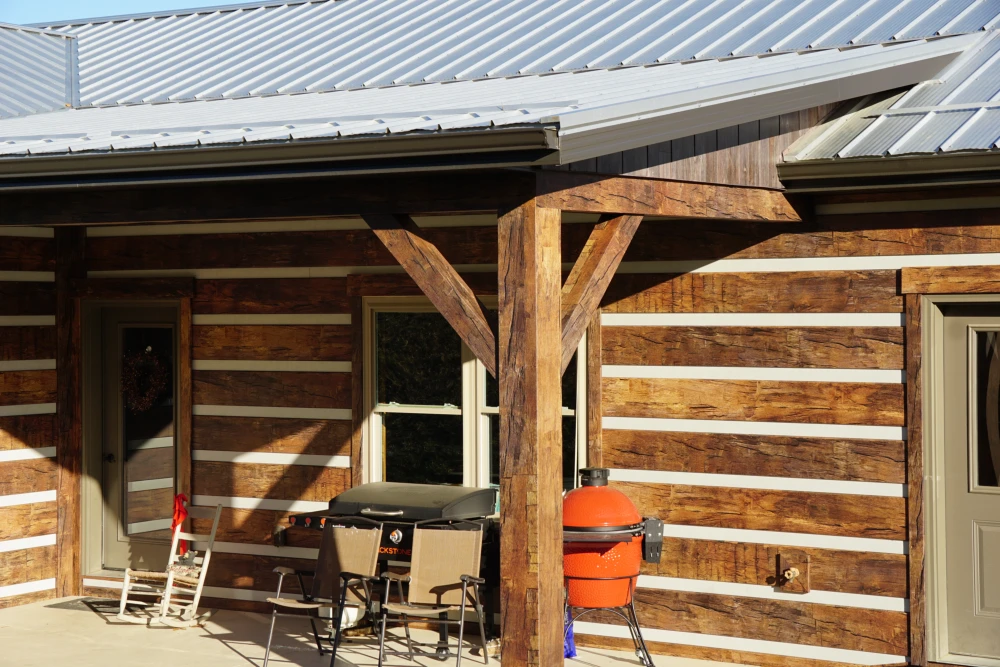
Hand hewn log siding with chinking in 26-gauge steel delivers that look without the maintenance and termite risk that come with real wood in Alabama's climate. The texture replicates actual milled log siding, with the dimensional variation of real logs. Chinking fills the joints in four colors: Ash Gray, Charcoal, Clay, and Sandstone Tan. From the street it reads as traditional log construction with filled joints, indistinguishable from the real thing.
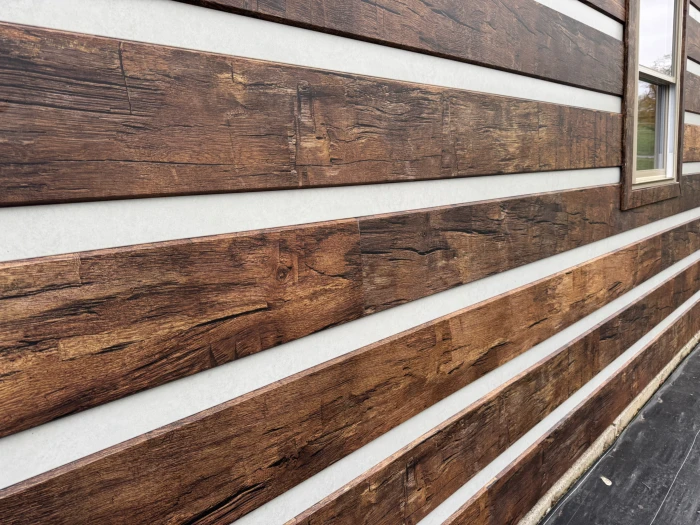
Alabama's termite environment makes the steel version far more practical than real wood log siding. Very heavy termite pressure statewide means colonies are actively working the soil in every Alabama county, and wood log siding gives them exactly what they need: food, moisture, and a place to get started. Not steel. Hand hewn log siding with chinking in steel has no organic material to eat, no moisture to absorb, and no way for a colony to get established.
SteeLuxe is the only steel siding manufacturer making hand hewn log siding with chinking. No other company makes it in steel. Every panel ships from New Philadelphia, Ohio direct to Alabama, with lead times short enough that they don't slow a project schedule down.
Ready to Transform Your Home With Hand-Hewn Log Cabin Siding?
Get the authentic hand-hewn cabin look with the chinking detail you love, and never think about maintenance again. SteeLuxe steel siding is insulated, fire-rated, hail-resistant, and built to last a lifetime. See it and feel it for yourself.
Steel Siding vs the Alternatives in Alabama
Alabama's climate eliminates some materials faster than most states. Here is what each alternative actually does when Alabama's conditions put it through the full test over a 10, 20, and 40-year period.
Steel vs Vinyl
Vinyl has three specific problems in Alabama: termites, heat, and hurricanes. On the termite side, vinyl doesn't provide food for termites directly, but it can be breached and chewed through, giving colonies access to the wood structure underneath, and it does nothing to stop them from getting there. Heat is the second problem: vinyl expands substantially in Alabama's sustained 90-degree summers and can pull loose from fasteners or gap at the seams over repeated heat cycles. Hurricanes are the third: vinyl carries no meaningful impact rating and has been documented pulling completely off homes in Gulf Coast wind events. Steel panels lock together mechanically and stay put.
Steel vs Fiber Cement
Fiber cement performs better than vinyl in high-impact conditions, but it has two liabilities in Alabama. Moisture is the first: Alabama's year-round humidity works water into fiber cement at a rate that makes paint peel every 7 to 10 years, and repainting a whole house every decade adds up fast over a 40-year period. Termites are the second problem. Fiber cement itself isn't organic, but the product typically requires wood furring strips underneath to install, and those give termites a route into the wall. Steel panels install over the existing structure without added wood.
Steel vs Wood
Wood siding in Alabama is fighting termites and humidity simultaneously, and it loses both fights over time. Very heavy termite pressure statewide means colonies are actively working the soil in every Alabama county. Wood siding gives them food, moisture, and an entry point. High humidity accelerates paint failure, compressing the maintenance cycle to every 4 to 6 years in the more humid parts of the state. On the Gulf Coast, add hurricane wind loads and salt air corrosion, and wood siding's useful life gets cut further still. Steel removes all three liabilities in one material choice.
Frequently Asked Questions
Q:How long does SteeLuxe steel siding last in Alabama's climate?
Q:Is steel siding more expensive than vinyl or fiber cement?
Q:Does steel siding dent?
Q:Can steel siding be painted?
Q:Is termite-resistant siding actually worth it in Alabama?
Q:Does steel siding hold up in a hurricane?
Q:How does steel siding handle Alabama's heat and humidity?
Q:What Alabama cities does SteeLuxe serve?
Q:Why do Gulf Coast homeowners replace their siding after a hurricane?
Alabama Cities & Regions We Serve
SteeLuxe ships from New Philadelphia, Ohio to residential and commercial projects across Alabama, and because the state is within a short haul from the plant, lead times are short anywhere in it.
Birmingham is Alabama's biggest siding market. The metro and the surrounding Tennessee Valley communities face the state's most active hail season from March through May, combined with very heavy termite pressure and sustained summer humidity. Huntsville and Madison County, to the north, sit in the same storm corridor. Montgomery, in the center of the state, carries the Black Belt's heat profile and very heavy termite pressure throughout its surrounding counties. Tuscaloosa sits between the two zones and shares conditions with both.
Mobile and the Gulf Coast are a different market. The combination of hurricane exposure, salt air moving inland through Mobile Bay, and the highest termite pressure in the state means every performance claim about steel siding applies at once down here. Gulf Shores and Orange Beach are primarily second-home and resort markets where storm-rated materials have become the standard for new construction and siding replacement after hurricanes Katrina and Sally.
Full city pages are available for Birmingham, Montgomery, Huntsville, Mobile, and Tuscaloosa, each with local installer contacts, current pricing, and condition-specific data for that part of the state. More Alabama cities across all 67 counties are in the list below:
If your city isn't listed, contact SteeLuxe directly and someone familiar with Alabama's regional conditions will help you find the nearest installer, get current pricing, and answer any questions specific to your area.
Get a Quote for Steel Siding in Alabama
SteeLuxe is manufactured in New Philadelphia, Ohio and ships direct. Whether you are planning a full re-siding project or exploring options, we can get you pricing, color samples, and a list of installers in your area.